









Modern HPC teams run tightly-coupled MPI jobs and data-hungry AI on the same clusters, but the storage underneath was tuned for one pattern, not both. Keeping a parallel file system fast means constant tuning, staging, and duplicate infrastructure, and every hour of downtime on a multi-week job is compute you never get back.
VAST Data for High Performance Computing
Feed Every Core and Every GPU From One Flash Namespace
An HPC job can run for weeks. It should not lose an hour to a stalled data path or a tuning pass. VAST DataStore serves large sequential simulation I/O and millions of random small-file AI reads from one all-flash namespace, with no Lustre or GPFS tuning to maintain, so tightly-coupled MPI and GPU training run on the same system.
The HPC Data Challenge
Simulation Scales. The File System Fights Back.
Feed Every Core at Peak Speed
Lustre and GPFS deliver throughput only after endless tuning of stripe counts, metadata servers, and client settings. Every new workload or scale-out point resets the treadmill, and the specialists who keep it running are scarce and expensive.
One System Cannot Serve Two Patterns
Tightly-coupled simulation wants large sequential I/O. AI training wants millions of random small-file reads. Parallel file systems hit a metadata-latency wall on the small stuff, forcing teams to stage data or stand up a second, duplicate cluster.
Downtime You Cannot Afford
Jobs run for days or weeks, so a controller failure, a disruptive upgrade, or a rebuild storm can erase enormous amounts of compute. At exascale the odds of component failure only rise, and older designs were not built to ride through it.
We have all possible use case combinations that you can think of. HPC, Cloud, AI, and big data. Everything is on top of VAST.
Daniele Cesarini
Vice Chair of EuroHPC, Project Manager & HPC Technology Specialist, CINECA

Why Now
The Parallel File System Was Built for a Problem You No Longer Have
For decades, HPC storage optimized for one thing: streaming huge, sequential writes from thousands of nodes to disk as fast as possible. Lustre and GPFS were engineered around exactly that. The price of admission was complexity, constant tuning, and a team of specialists to keep it fed.
Then the work changed. HPC and AI collapsed onto the same clusters, and one clean sequential stream stopped describing it. Now the demand is tightly-coupled MPI simulation and millions of unpredictable small-file reads for training and inference, side by side. Bolt AI onto a disk-based parallel file system and you stage data, stand up a duplicate all-flash tier, or watch GPUs idle while metadata catches up.
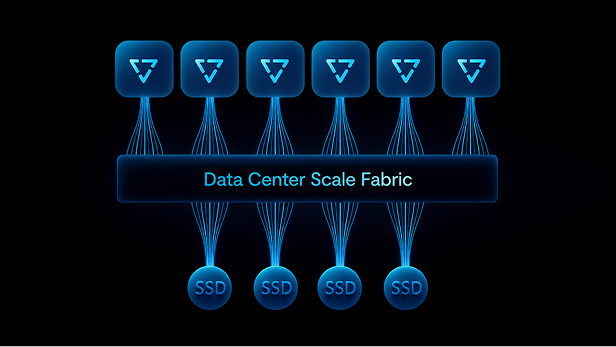
VAST’s Disaggregated and Shared-Everything (DASE) architecture separates stateless compute (CNodes) from the media (DNodes) over NVMe-oF, so every CNode reaches every SSD directly. No cross-node chatter. No central metadata server in the path. No stripe tuning. Throughput grows by adding CNodes, capacity grows independently by adding DNodes, and both sequential simulation I/O and random AI reads run fast on one all-flash namespace. The result is HPC-class throughput and NAS-class simplicity on a single system, at exascale, engineered to ride through the failures that weeks-long jobs make inevitable.
VAST DataStore for HPC
One All-Flash System for Simulation and AI
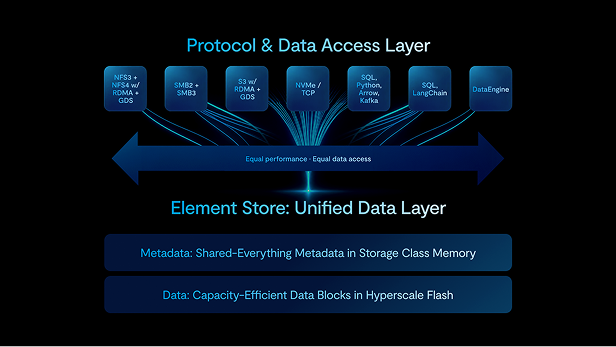
VAST DataStore gives HPC teams parallel-file-system performance without the operational tax. Files, objects, and volumes live as native Elements in one global namespace on the DASE architecture, so tightly-coupled simulation and data-intensive AI share the same storage with no staging, no duplicate clusters, and no tuning treadmill.
Saturate Every Core and GPU
DASE removes stripe counts, metadata-server sizing, and client-side tuning. Because every CNode reaches every SSD over NVMe-oF, throughput scales by adding stateless compute rather than by hand-tuning the file system for each new job.
Unify HPC and AI
One namespace serves large sequential MPI I/O and millions of random small-file reads at flash speed. No staging between tiers, no second cluster for training, and no metadata wall on the small-file patterns AI depends on.
Run Through Failure
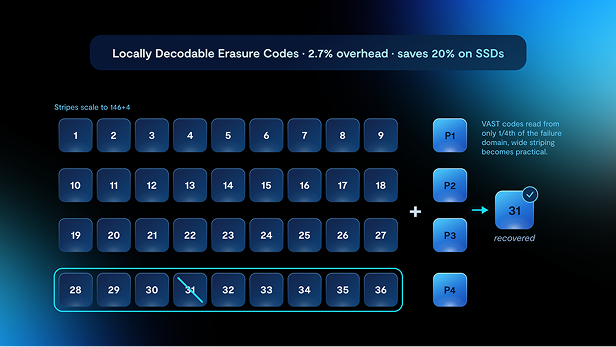
Wide erasure stripes hold data intact through four concurrent SSD failures at 11 nines of durability, and upgrades run non-disruptively, so multi-week jobs survive the component failures that exascale makes routine.
More Compute per Watt
All-flash efficiency and data reduction of up to 3:1 keep dense simulation and AI datasets in a fixed power and floor-space budget, improving performance-per-watt over disk-based parallel tiers.
How It Works
Performance Without the Complexity
Three architectural choices let VAST deliver parallel-file-system throughput, unified HPC and AI, and reliability at scale, without the tradeoffs legacy file systems force on HPC teams.
Throughput and Small-File Speed on One Namespace
Parallel file systems reach high aggregate bandwidth but stall on metadata-heavy, random small-file access, which is exactly the pattern AI training and inference generate. VAST DataStore serves large sequential simulation I/O and millions of small random reads from the same all-flash namespace, because DASE gives every CNode direct NVMe-oF access to every SSD with no central metadata server arbitrating requests. The result is one system that feeds MPI simulation and GPU training at full speed, with no staging step between them.
Why VAST DataStore?
The Storage Foundation for Converged HPC and AI
VAST DataStore is universal storage built on the DASE architecture. It persists files, objects, and volumes as native Elements in one global namespace, scales to exabytes, and delivers flash performance for both tightly-coupled simulation and random-access AI, so HPC centers run one system instead of a parallel file system plus a separate AI tier.
Exascale in One Namespace
Add stateless CNodes for throughput and DNodes for capacity independently, scaling to exabytes without re-architecting. Every client sees the same global namespace across files, objects, and volumes, with no islands to stitch together.
GPUDirect Storage for AI
DataStore feeds GPUs directly with GPUDirect Storage, so AI training and inference on the HPC cluster read data at flash bandwidth without a CPU bounce, keeping accelerators saturated during data-heavy phases.
Efficiency That Fits the Power Budget
Data reduction of up to 3:1 and 20x flash longevity keep dense datasets on all-flash within a fixed power envelope, delivering better performance-per-watt than disk-based parallel tiers you have to over-provision.
HPC in Action
Proven Where Every Cycle Counts
HPC teams across research and industry run VAST DataStore where downtime is unacceptable and workloads mix tightly-coupled simulation with data-intensive AI. These are the environments that put the architecture to the test.

National Labs and Research Computing
Exascale research centers run simulation and AI on shared clusters where jobs span weeks. VAST DataStore delivers the throughput of a parallel file system with the operational simplicity of NAS, and non-disruptive upgrades keep long-running science online.



Retire the Parallel File System Tax
See what VAST DataStore does for your simulation and AI workloads — full throughput and small-file speed in a single namespace, without the tuning treadmill or a team of specialists to keep it running.