



SSD Scarcity & Infrastructure Efficiency

The SSD Shortage Is Exposing a Deeper Architectural Failure

Flash supply constraints are tightening. But for most enterprises, the real problem isn’t what they can’t buy, it’s what their architecture wastes. Replication alone can consume up to 66% of raw flash capacity. Add siloed protection domains and overprovisioning, and most organizations lose the majority of deployed flash before a single byte is written. VAST eliminates that waste at the platform level.

VAST Data image
The Flash Scarcity Constraint

Why Flash-Constrained Organizations Are Looking at the Wrong Variables

When storage capacity tightens, the instinct is to look at procurement: lead times, spot price per TB, next delivery window. These are legitimate questions, but they address the smaller half of the problem.

Legacy storage platforms were designed when HDDs were primary and replication was cheap. Those assumptions — replication-based protection, per-system data reduction, siloed capacity pools, performance-driven overprovisioning — now consume enormous amounts of flash before a single byte is written.

Enterprises that believe they have a supply problem more often have an architectural efficiency problem that the supply chain cannot fix. As SSD prices rise and lead times stretch, these inefficiencies directly constrain AI pipelines, force deletion of historical data, and inflate infrastructure budgets without delivering proportional capability.


Four Architectural Drains on Flash Capacity

Full Data Replication

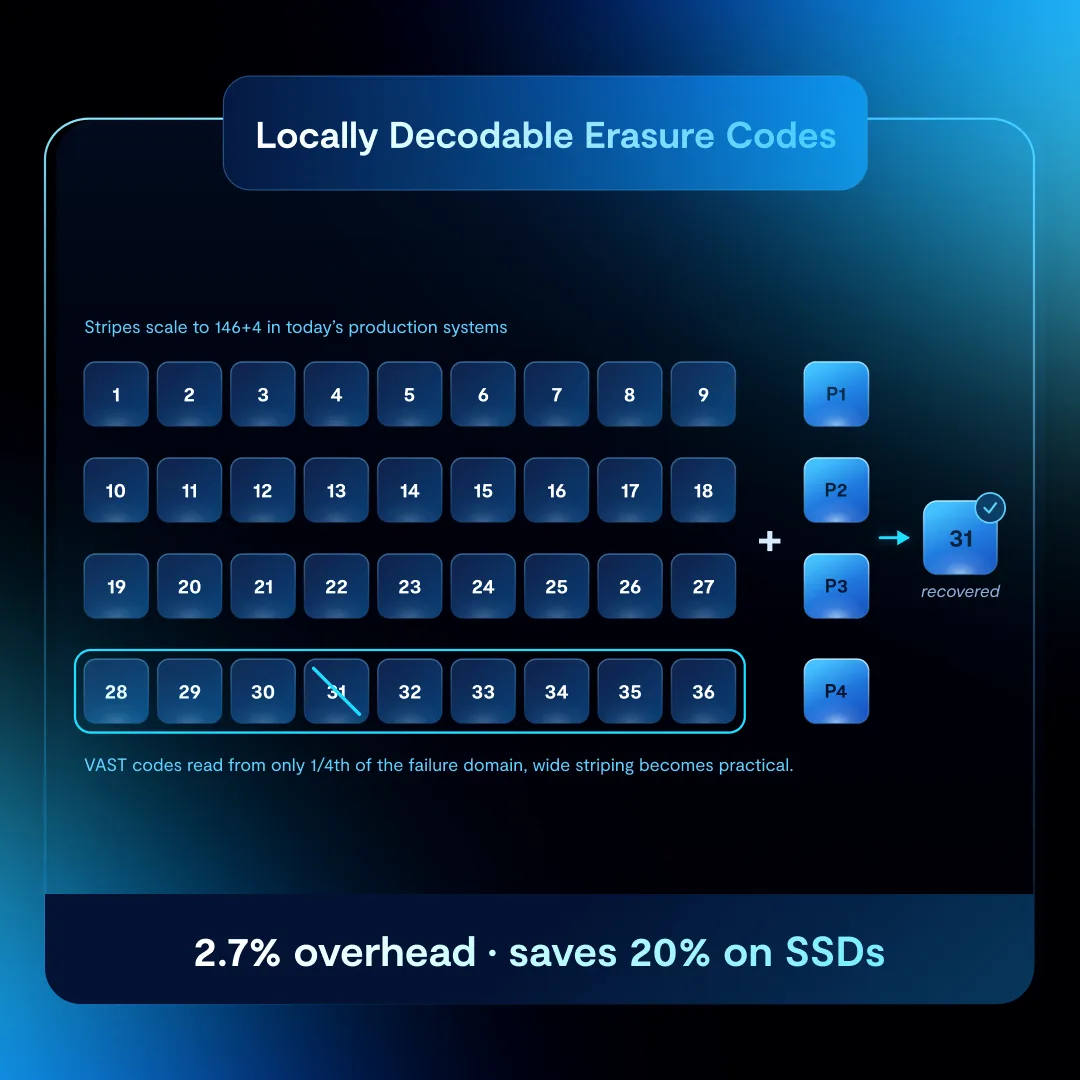
A 3× replicated system dedicates two-thirds of raw flash to redundant copies. It’s capacity that serves no function unless a failure occurs. A 2× system still loses half. The majority of deployed flash in conventionally protected estates never stores any production data. On a 10 PB estate, the gap between 3× replication and VAST’s Locally Decodable Erasure Codes is ~6.4 PB of recovered capacity from hardware already racked.

Siloed Architecture: Redundant Copies Across Every System

Most enterprises run separate systems for NAS, object storage, databases, streaming, and AI. Each maintains its own protection scheme with local-only deduplication. The same dataset routinely exists in multiple copies across silos, each paying full protection overhead independently.

Performance-Driven Overprovisioning

Storage platforms reserve raw flash for write buffers, wear leveling, and operational metadata. VAST’s total system reserve is 9%. Shared-nothing competitors lose 21–28% of raw capacity to architecture overhead alone. Many layer additional performance reserves on top. The result: a quarter or more of deployed flash consumed before workloads run.

Fragmented, Local Data Reduction

Deduplication and compression applied per-volume or per-node can only eliminate redundancy within those boundaries. A small data chunk deduplicated on one system is written in full on every other system storing the same data. VAST’s architecture reduces total overhead to under 12%: 3% parity from Locally Decodable Erasure Codes, plus 9% system reserve.