The standard continuity model bills you twice: once for the array that runs production, and again for a passive standby system that idles in another rack waiting for a bad day that may never come. That standby is not free insurance - it is stranded capital, a second license, and a recovery runbook few teams ever test at full scale. Worse, the standby is itself a liability. Replication lags behind the last sync, failover procedures drift out of date, and the system you were counting on turns a site event into a multi-day rebuild. You spend real money to make availability more fragile, not less.
Business Continuity on the VAST AI Operating System
No Standby Cluster, No Degraded Failover, No Downtime
A failed controller, a lost site, or one fat-fingered command should never stop the work your business runs on. Most availability plans answer each of those conditions with a separate system you pay for and pray is never needed. VAST DataStore builds continuity into the primary flash tier, so availability is a property of the architecture, not a product you bolt on afterward.
The Continuity Gap
You Pay Full Price for a Second Cluster That Does Nothing Until Disaster
Controller Failure Halves Performance
When a storage controller fails, a dual-controller array fails over to a single surviving head and cuts throughput in half exactly when jobs are most exposed. The rebuild runs for hours, and a second failure inside that window means data loss.
Site Loss Means Stranded Data
A power event, a network failure, or a facility outage takes an entire site offline. Standby clusters sit idle and costly, replication trails the last sync, and failover runbooks that were never fully exercised turn a bad day into a multi-day outage.
One Wrong Command, No Way Back
Operator error causes more outages than hardware ever will. A mistaken delete, a bad script, or a misapplied configuration change can destroy live data in seconds, and backup-based recovery drags production down for hours while you restore from a separate tier.
We've done three rolling upgrades while Stampede3 has been in production and we have had zero downtime on VAST.
Tommy Minyard
Advanced Computing Systems Directorate, TACC
Why Now
Continuity Stopped Being a Separate Tier
Continuity used to be something you bought a second time. Production ran on one array. A standby system mirrored it. A backup appliance waited in a third rack for the worst case. Each layer carried its own license, its own performance profile, its own recovery procedure. You assembled availability from parts and hoped it would hold the day you needed it.

The VAST AI Operating System
Availability as a Property of the Architecture
VAST DataStore treats continuity as a design characteristic, not a feature you purchase separately. Because compute and capacity scale independently on the Disaggregated Shared Everything (DASE) architecture, the system absorbs component failures without a performance cliff, protects live data against operator error in place, and extends across sites through one namespace. Here is what that gives your continuity plan.
Survive Component Failure
Stateless CNodes each reach every SSD over NVMe-oF, so while losing a CNode or several drives subtracts headroom, every request still finds its data. The cluster keeps serving at full performance while it heals, with no failover to a degraded single head.
Recover From Operator Error Instantly
Immutable snapshots live on the same flash tier as production. Roll back a mistaken delete or bad change in seconds without staging a restore from a separate backup appliance or dragging production offline.
Redirect Around Site Loss
VAST DataSpace spans a single namespace across data centers, on-premises and cloud, using synchronous and asynchronous replication. When a site goes dark, work continues against the same data elsewhere rather than waiting on a full failover rebuild.
Retire Standby Sprawl
Continuity built into the primary tier removes the idle standby cluster and the separate backup silo. You protect production on the infrastructure you already run, ending the bill for capacity that sits passive until disaster.
How Continuity Is Built In
Three Layers of Protection, One System
Continuity has to protect against three very different failures: a piece of hardware dies, someone makes a mistake, or an entire site disappears. Each demands a different mechanism, and each is native to VAST DataStore rather than assembled from separate products.
Hardware Failure Without a Performance Cliff
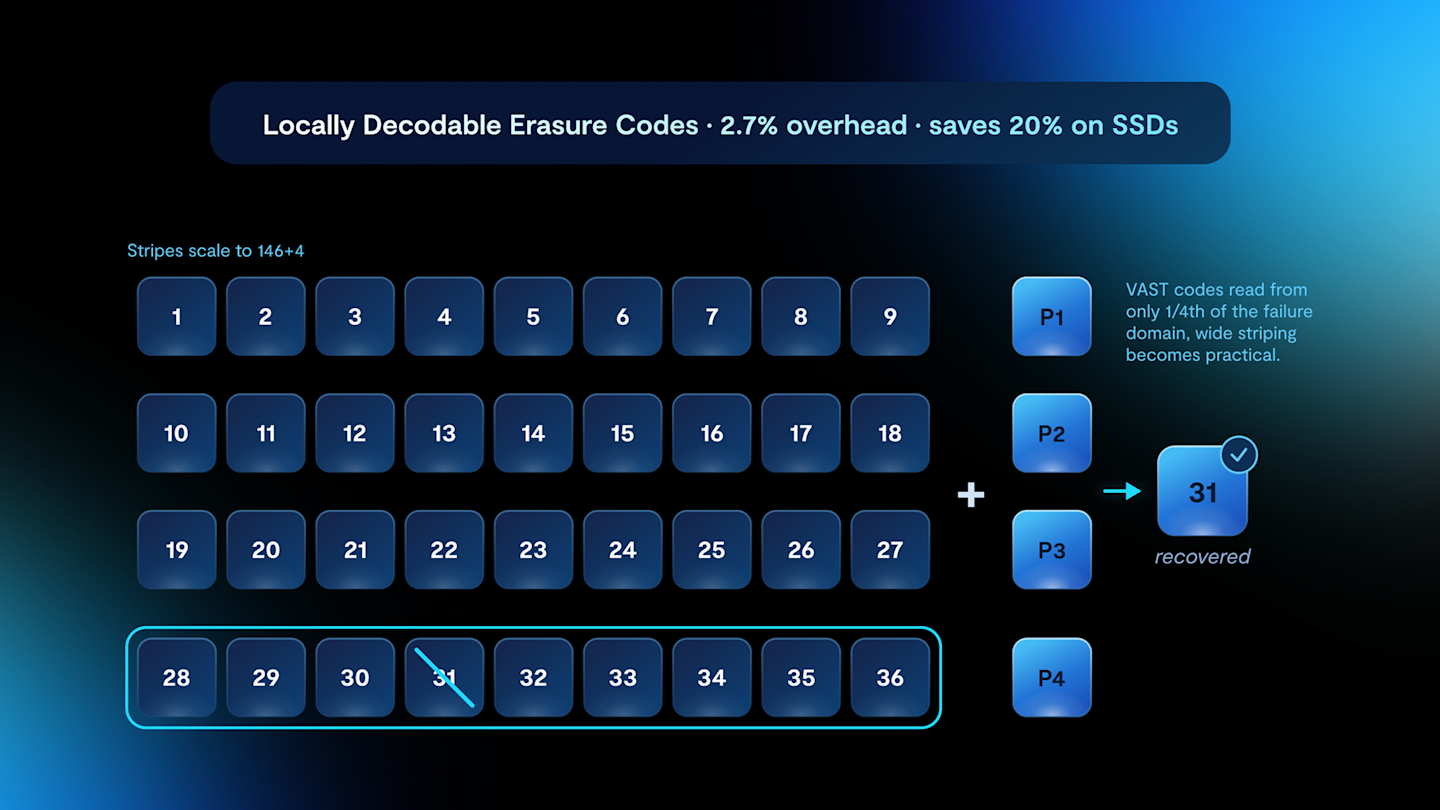
Traditional dual-controller arrays route all I/O through two heads. Lose one, and performance halves while a rebuild runs for hours, leaving you one failure away from data loss. VAST DataStore separates stateless CNodes from the DNodes holding data on hyperscale flash, and any CNode can serve any request over NVMe-oF. A CNode loss subtracts headroom while data stays reachable, and wide erasure-coding stripes tolerate four simultaneous SSD failures at 2.7% overhead. The result is a system that keeps serving at full performance while it repairs itself, with 11 nines of durability by design.
Instant Recovery From Operator Error
Most outages start with a person, not a part: a mistaken delete, a bad script, a config pushed to the wrong system. The usual response is to restore from a separate backup tier, which pulls production offline for hours. VAST DataStore keeps immutable, space-efficient snapshots on the same platform on which you run production. Because they cannot be altered or deleted by an errant command, you roll back to a known-good state in seconds rather than rehydrating from a slow tier. The result is recovery measured against your operations, not your backup window.

Site Loss Becomes a Redirect
When a facility goes offline, standby-cluster designs force a failover procedure that few teams test at full scale and fewer trust under pressure. VAST DataSpace presents one global namespace across sites, on-premises and cloud, with synchronous and asynchronous replication and Global Clones. Work follows the data to a surviving location instead of waiting on a rebuild, and Global Clones move only changed blocks so you avoid paying egress twice to bring it back. The result is continuity that treats a lost site as a change of address, not a disaster.
Why VAST DataStore for continuity?
Continuity Native to the Primary Flash Tier
VAST DataStore is universal storage that persists files, objects, and volumes as native Elements in one namespace on the DASE architecture. It is the same tier that keeps GPUs fed for training and inference, which means your production data and your continuity strategy live on one system rather than three. Availability comes from how the storage is built, so there is nothing extra to license, stage, or test into readiness.
No Degraded Failover Mode
Because every CNode reaches every SSD over NVMe-oF, there is no primary or standby head to fail over to. A component loss reduces available headroom while the cluster serves at full speed, so a bad day never becomes a slow day.
Immutable Snapshots In Place
Snapshots are space-efficient and cannot be modified or deleted by a compromised account or a wrong command. Recovery from operator error happens on the primary tier in seconds, not through a restore from a separate appliance.
Non-Disruptive Upgrades at Exabyte Scale
Software and hardware refreshes happen without taking the cluster offline, which matters when jobs run for weeks and you cannot afford an hour of downtime. Continuity holds through planned maintenance, not just unplanned failure.
Why VAST DataSpace for continuity?
One Namespace That Spans Every Site
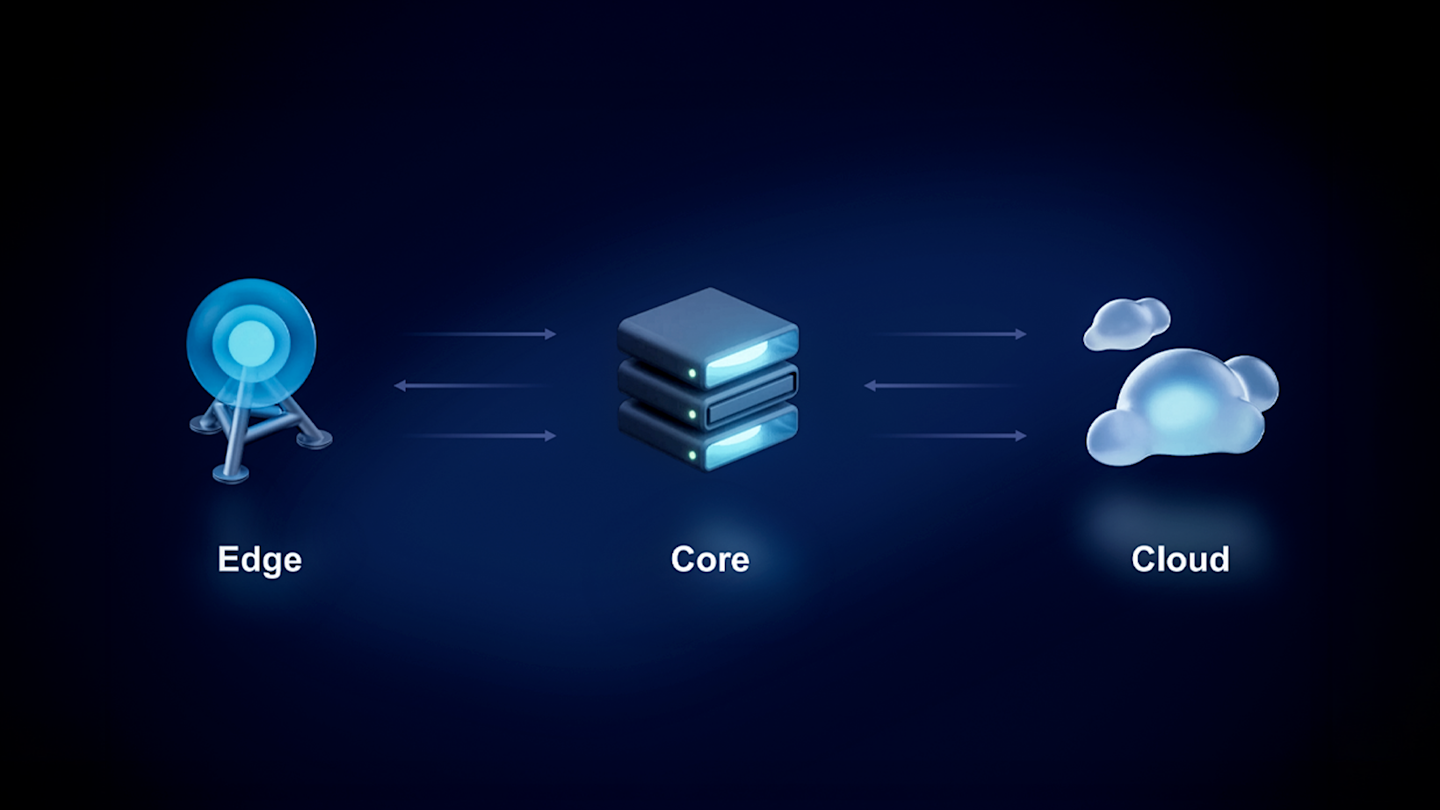
VAST DataSpace is the globally distributed namespace and data-computing layer that extends DataStore across on-premises, cloud, and edge. For business continuity it turns multiple sites into one logical system, so a facility outage redirects work rather than triggering a rebuild. It is how a single-site availability story becomes a multi-site resilience story without duplicating your entire estate.
Global Namespace Across Sites
Data presents as one namespace whether it lives in one data center or several. When a site goes dark, applications reach the same data elsewhere without remapping mounts or repointing clients through a manual failover.
Synchronous and Asynchronous Replication
Match the replication mode to the recovery objective. Synchronous replication commits writes to a paired site before acknowledging them, targeting zero data loss between sites; asynchronous replication trades tighter sync for distance and cost. Both run within one namespace rather than a separate replication product.
Global Clones Without Egress Double-Pay
Spin up a working copy of a dataset at another location without re-copying it back and paying egress twice. Recovery and failback move only what changed, keeping continuity affordable across regions and clouds.
Continuity in Practice
What Uninterrupted Looks Like by Industry
The cost of downtime differs by sector, but the requirement is the same: production keeps running through failure, error, and site loss. Here is how continuity built into the primary tier plays out where the stakes are highest.