Exascale HPC Performance. Enterprise Simplicity
Run your most demanding HPC and AI workloads with the performance and scale of a parallel file system and the simplicity of NAS, at archive economics. Built on DASE (Disaggregated and Shared Everything), VAST AI OS decouples compute from storage so everything runs on one all-flash platform, without the rigidity and overhead of legacy architectures.
Trusted by the World’s Leading Data-Driven Organizations
Built for the I/O Demands of Modern HPC
Legacy parallel file systems were built for a world that no longer exists, before AI pipelines, exabyte scale, and zero tolerance for downtime became the baseline. The result: I/O bottlenecks that starve GPUs, disruptive upgrades that kill multi-week jobs, and storage teams buried in maintenance instead of enabling science. From tightly coupled MPI to multi-week AI training, VAST AI OS handles every I/O pattern without staging, silos, or re-architecting.
Keep GPUs and CPUs Fed. Always.
A fully parallel data and metadata path sustains throughput at any scale, across mixed sequential MPI and random AI I/O patterns. The exact workload profile that degrades Lustre and GPFS under load. Long-running simulations and multi-week AI training runs complete on schedule, without stalls or retries.
Scale to Exabytes Without Re-Architecting
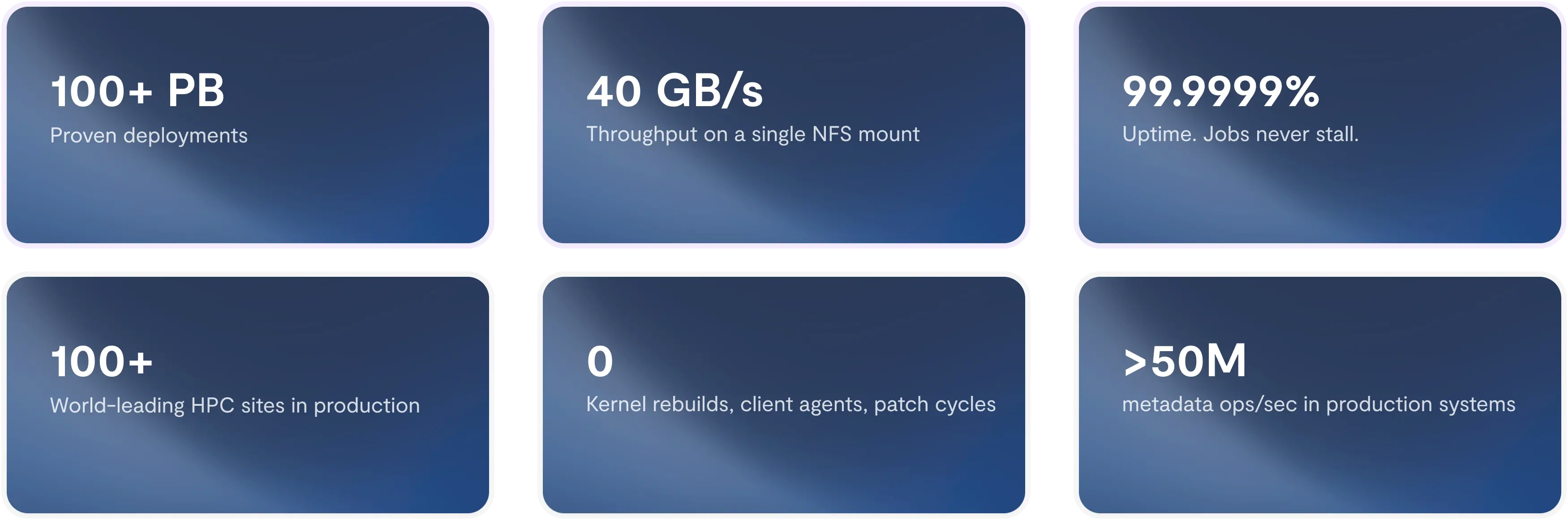
DASE decouples storage media from the servers that manage it. Capacity and performance scale independently, live, with no namespace fragmentation, no disruptive rebalancing, no cluster downtime. Proven in deployments beyond 100 PB. The same architecture that runs petabytes today scales to exabytes tomorrow without a forklift.


Operations That Run Themselves
Standard NFS delivers parallel file system performance. No proprietary client stack, no kernel rebuilds, no version matrix to manage. Rolling upgrades and self-healing run with zero downtime. Multi-week jobs survive infrastructure changes without interruption.
All Workloads. All Protocols. Zero Overhead.
When your team spends less time tuning and troubleshooting storage, they gain more time to run simulations and accelerate discoveries. VAST AI OS is the unified platform that makes that shift permanent.
All-Flash HPC Storage at Archive Economics
Deploy all-flash infrastructure or across all data sets. VAST’s advancements in flash management, data protection, and data reduction deliver a lower TCO than hybrid HPC storage systems combining high-performance storage with cost efficiency.
Enterprise NAS Simplicity at HPC Scale
Eliminate the need for tiering appliances, client agents, data migrations, and other complexities with a single, easy-to-manage HPC storage solution built for simplicity at scale.
Native Multiprotocol: NFS, SMB, S3, Block
A unified, multi-protocol HPC storage platform for both unstructured data (NFS, SMB, S3) and structured data. Eliminate data silos and simplify analytics infrastructure with native SQL applications and modern query engines like Spark and Trino.
AI-Optimized Client Access
With support for NFS-over-RDMA and NVIDIA Magnum IO GPUDirect™ Storage access, VAST delivers the performance of a parallel file system, without the complexity.
Data-Efficient Cloud Bursting
Defeat data gravity with granular, policy-driven data access from anywhere in the VAST DataSpace.
Always-On HPC Storage with No Downtime
With always-online upgrades and expansions, and no complex tuning required, research teams gain faster insights and maximize productivity in high-performance computing environments.
Proven HPC Reliability
See It Running On Your Workload
Live demo against your actual I/O profile: MPI simulations, AI training, mixed workloads. Bring your benchmark numbers.
Join the VAST Community
Discover how visionaries, architects, and technologists are shaping the future of data. Collaborate, learn, and grow with the minds building tomorrow's data infrastructure.