VAST Named a Fast Follower in Everest Group Vector Data Platform Report
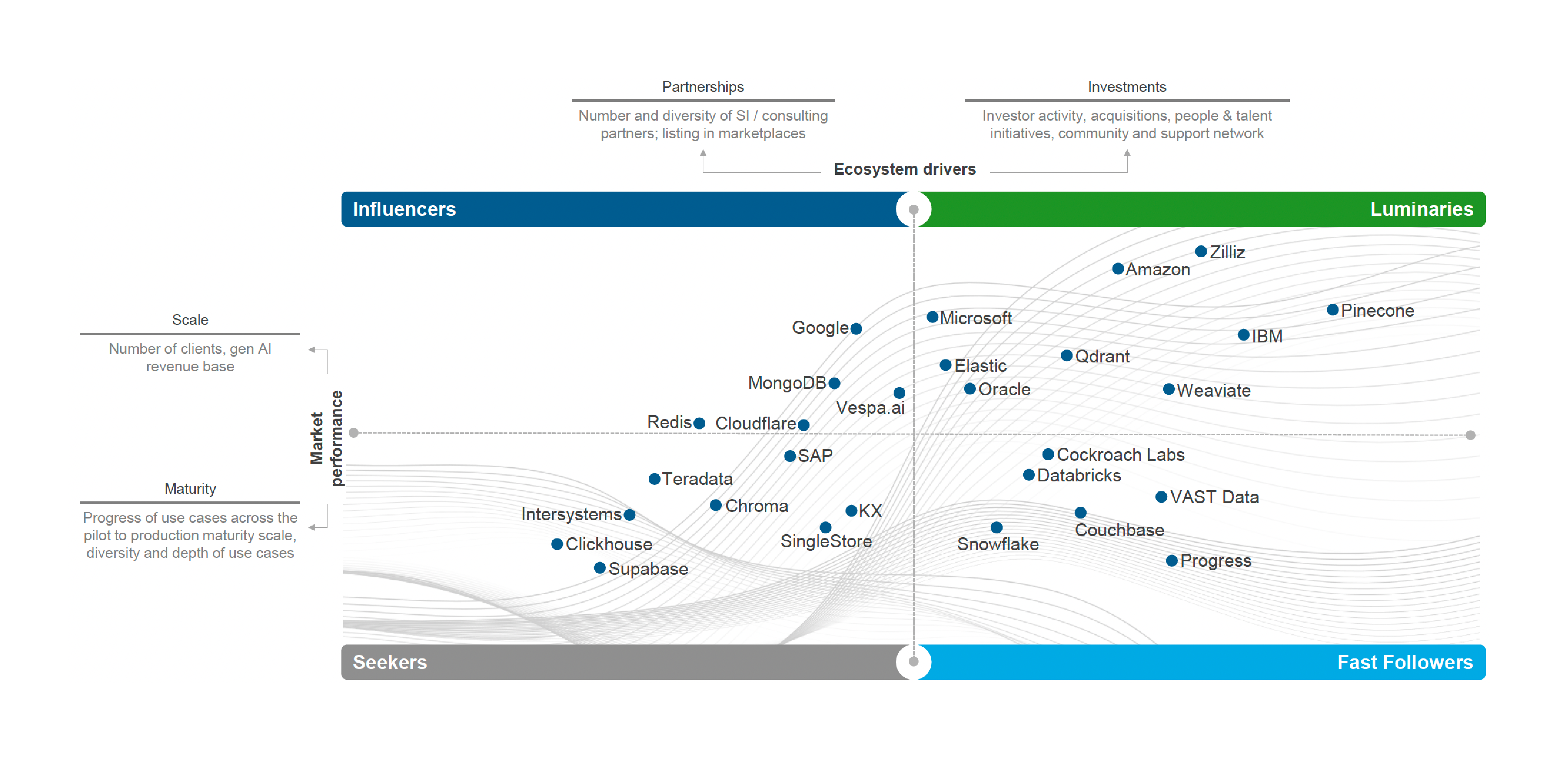
The VAST AI Operating System continues to expand its role in the AI infrastructure stack.VAST is relatively new to the vector database market, but its architecture is already earning industry recognition. In its 2026 Innovation Watch: Vector Data Platforms, Everest Group evaluated 28 leading providers and positioned VAST as a Fast Follower, recognizing the VAST AI OS for its integrated approach to storage, database, compute, vector data, and real-time data processing.
The recognition comes as vector search becomes an increasingly important part of production AI infrastructure. RAG, semantic search, recommendation systems, agent memory, and multimodal applications all depend on the ability to store and retrieve increasingly large collections of embeddings quickly and efficiently. Everest Group identifies persistent storage, efficient indexing and retrieval, enterprise governance, and integration with broader AI/ML ecosystems as key requirements for production-grade vector platforms. These requirements increasingly favor architectures that treat vector retrieval as part of the broader enterprise data platform rather than as an isolated service.
The challenge is that many vector databases were designed around assumptions that begin to break down at scale: indexes that need to remain in memory and sharding to distribute growing datasets. As vector collections reach tens or hundreds of billions of vectors, these architectures introduce increasing memory, coordination, and operational overhead.
VAST takes a different architectural approach.
The VAST Vector Database is built directly into the VAST AI OS and uses a hierarchical clustering architecture designed to scale from billions to trillions of vectors without requiring the entire index to remain in memory or relying on shard-based scaling. The hierarchy progressively narrows the search space, keeping search behavior predictable as datasets grow.
That architecture has translated into significant performance advantages. In our benchmark at one billion 128-dimensional vectors, VAST delivered approximately 1,000 queries per second compared with 89 QPS for Milvus 2.6 - more than 11x higher throughput at 99 percent recall. At 50 billion vectors, VAST delivered approximately 91 percent lower cost per 1,000 searches compared with the leading open-source vector database configuration evaluated.
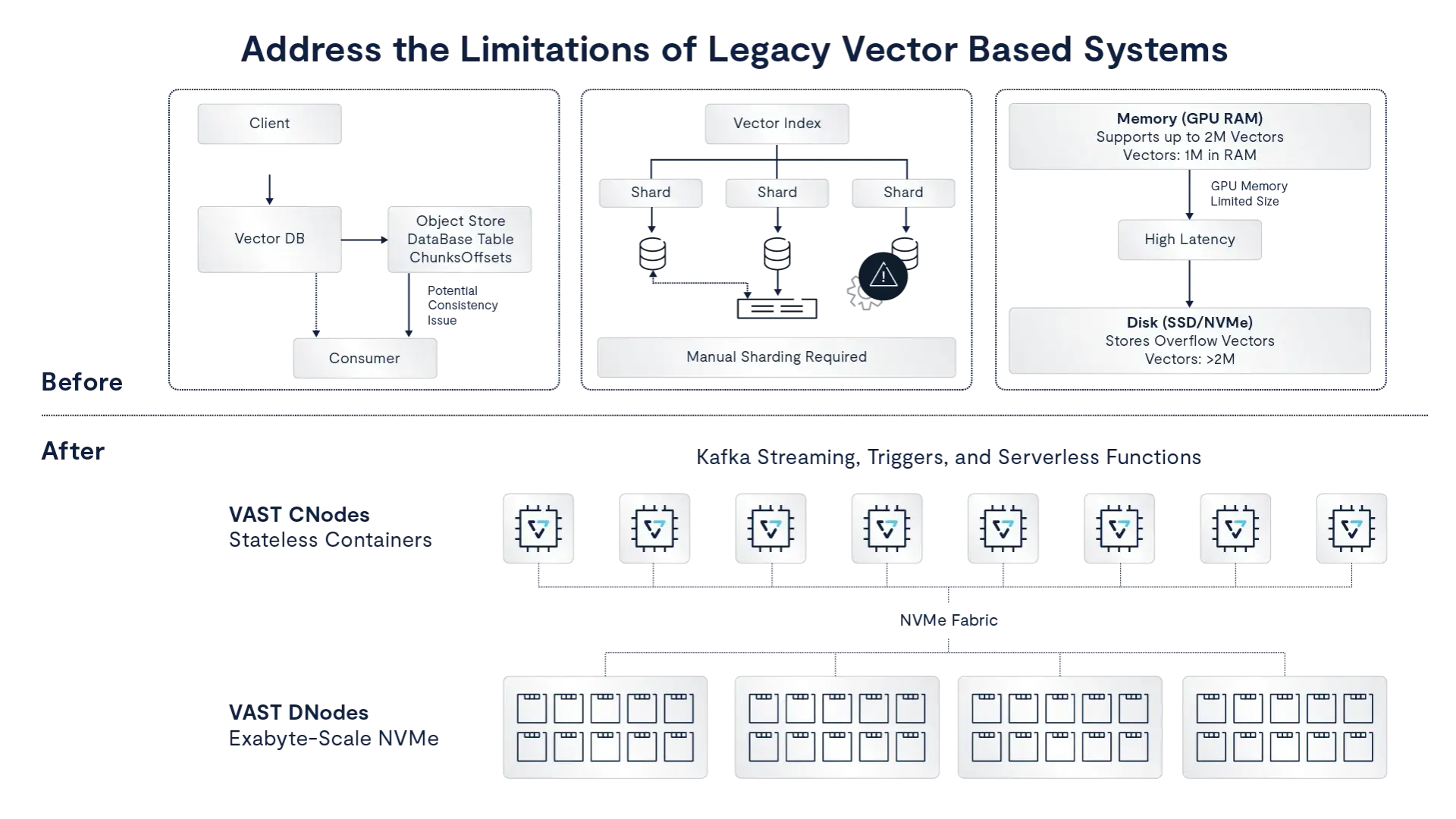
But vector search alone is only part of the story. Because the vector index is embedded in VAST DataBase, vectors can live alongside structured and semi-structured data, enabling hybrid queries that combine vector similarity with SQL predicates, joins, point lookups, updates, and deletes. There is no separate metadata synchronization layer or separate vector governance model; access controls remain atomic with the underlying data.
The platform is also designed for continuous AI workloads. Vectors can be ingested while background clustering reorganizes the index, with query performance remaining stable during clustering without index freezes or shard rebalancing events.
This combination of scale, performance, and unified access to vectors and enterprise data is the broader value of the VAST AI OS: bringing the data required for AI retrieval and context together on a common architecture. Vector search is an important capability, but its value increases when vectors, metadata, structured data, and real-time data can be accessed and governed together.
"VAST Data has emerged as a Fast Follower in Everest Group’s Vector Data Platforms Innovation Watch Assessment 2026, underpinned by its differentiated architecture, expanding partner ecosystem, and investment momentum,” said Amardeep Modi, Vice President at Everest Group. “Its ability to enable real-time vector processing, independently scale compute and storage, and support flexible hybrid and multi-cloud deployments provides a strong foundation for operationalizing AI workloads at scale."
Vector databases are one part of a broader transformation in enterprise data architecture. In a new paper, The Database Renaissance: AI’s New Center of Gravity and the Changing Economics of Enterprise Data, Everest Group examines how vector search, hybrid retrieval, and real-time processing are converging with traditional database capabilities and how enterprises can balance performance, scalability, and cost as AI workloads grow. Read the report to explore the trends shaping the next generation of AI data infrastructure.
Share this
More from this topic