Accelerating Next-Gen AI Workflows with VAST Data on Microsoft Azure

AI is moving fast, and enterprises are aggressively rethinking their cloud strategies to take advantage of powerful services like Microsoft Azure’s Foundry Models and AI Search. But while the compute and orchestration tools are readily available, the real value of AI lives in your data.
Today, we are thrilled to announce VAST on Cloud (VoC) for Microsoft Azure is generally available, bringing the VAST AI Operating System directly into the Azure ecosystem. By unifying files, objects, tables, and vectors into a single global namespace, organizations can extend a consistent data foundation from the data center all the way to Azure.
VAST AI OS is a software-defined, high-performance data platform specifically designed for enterprise AI, machine learning, analytics, and agentic AI. It delivers secure, governed access to enterprise knowledge.
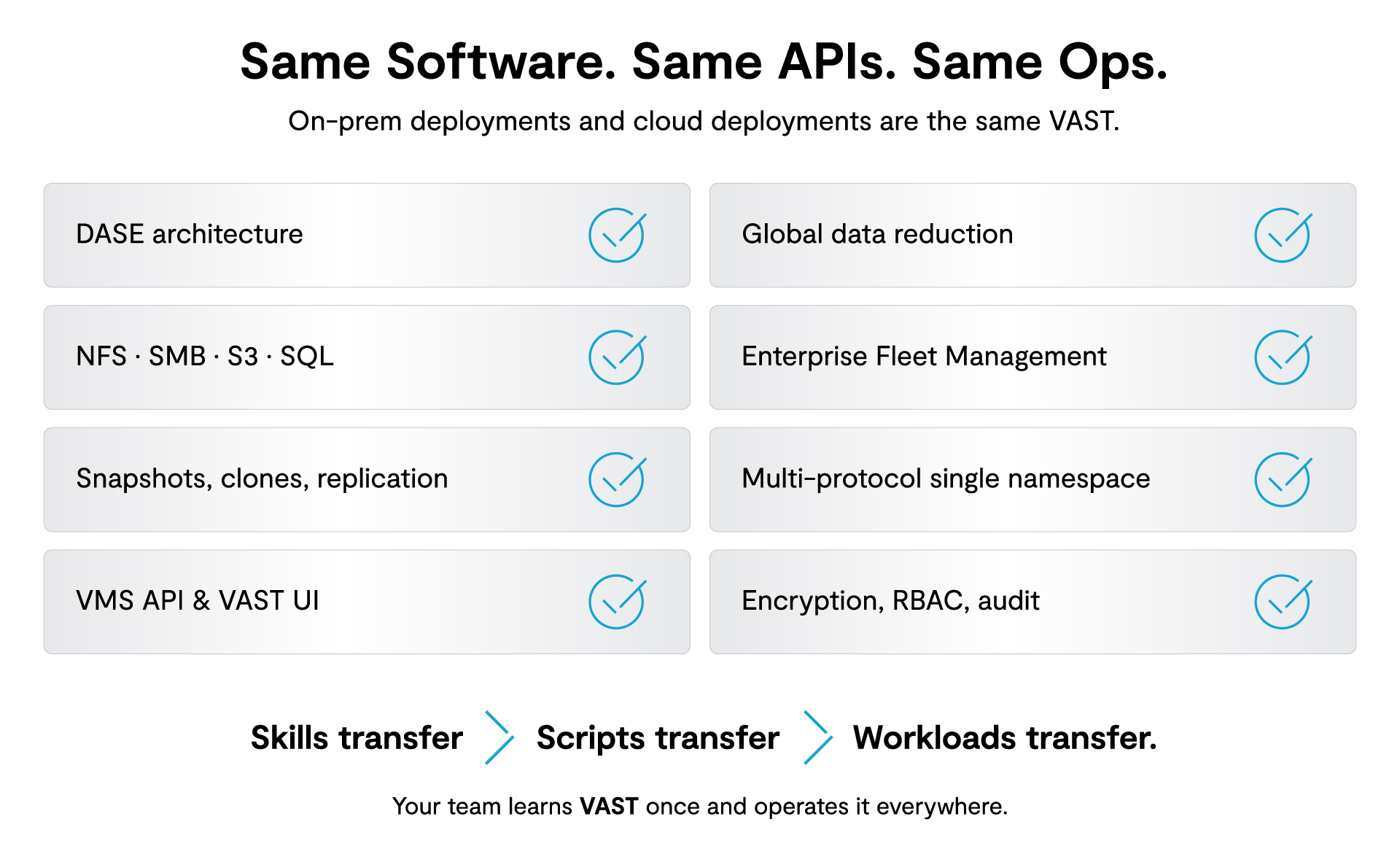
Moving from Legacy Constraints to AI Possibilities
Hybrid cloud adoption shouldn't mean managing a different data solution for every workload. VAST on Cloud for Azure eliminates the need for staging areas, separate vector stores, and duplicate data copies.
Running on Azure’s L-family storage-optimized virtual machines (VMs) equipped with locally attached NVMe (Non-Volatile Memory Express), VAST on Cloud delivers the high-throughput performance that AI workloads demand.
The VAST DataStore unifies structured and unstructured data using the VAST Element Store, which manages data in a protocol-independent format. Likewise, VAST on Cloud stores file and directory permissions internally in a protocol-independent format and translates them according to the security model configured for each view, helping to maintain consistent authorization across NFS, SMB, and S3.
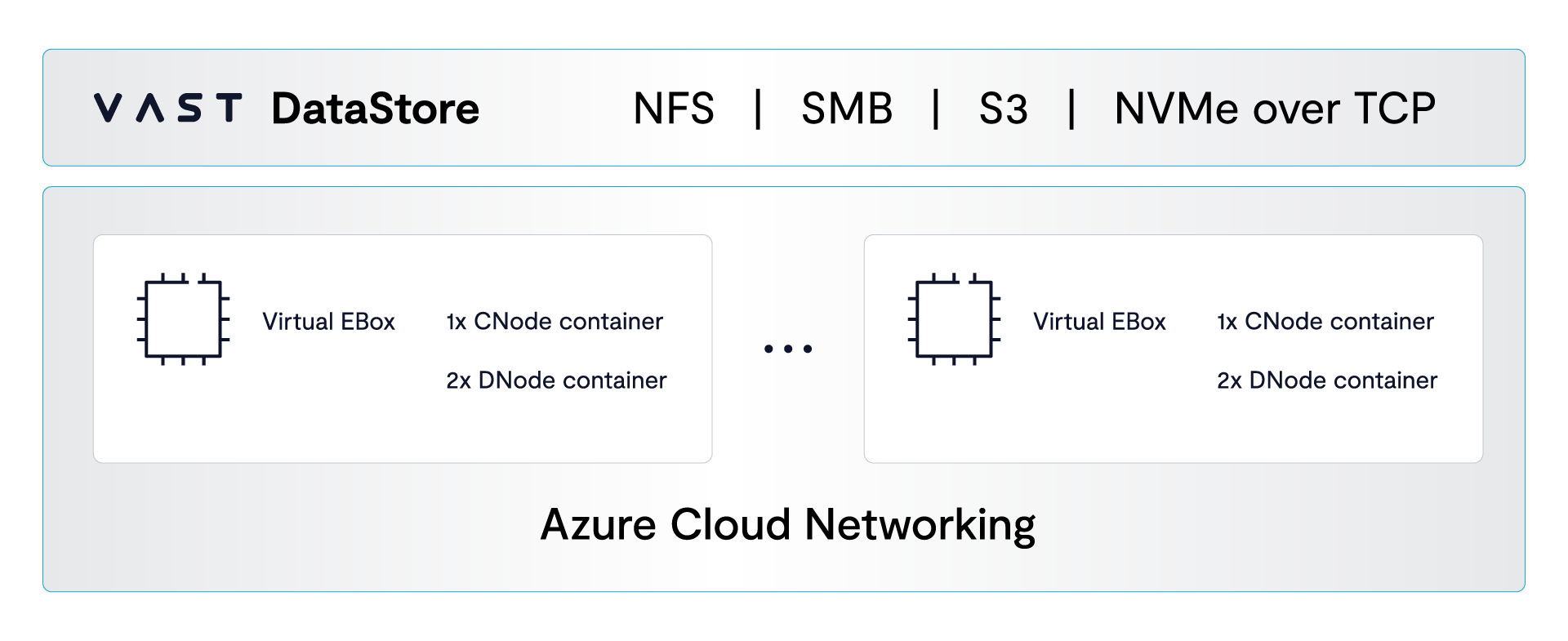
With VAST on Cloud for Azure, organizations can unlock several key capabilities for their AI pipelines:
1. Burst to Azure GPUs Without Losing Control
For many companies, moving every enterprise dataset is neither practical nor necessary.
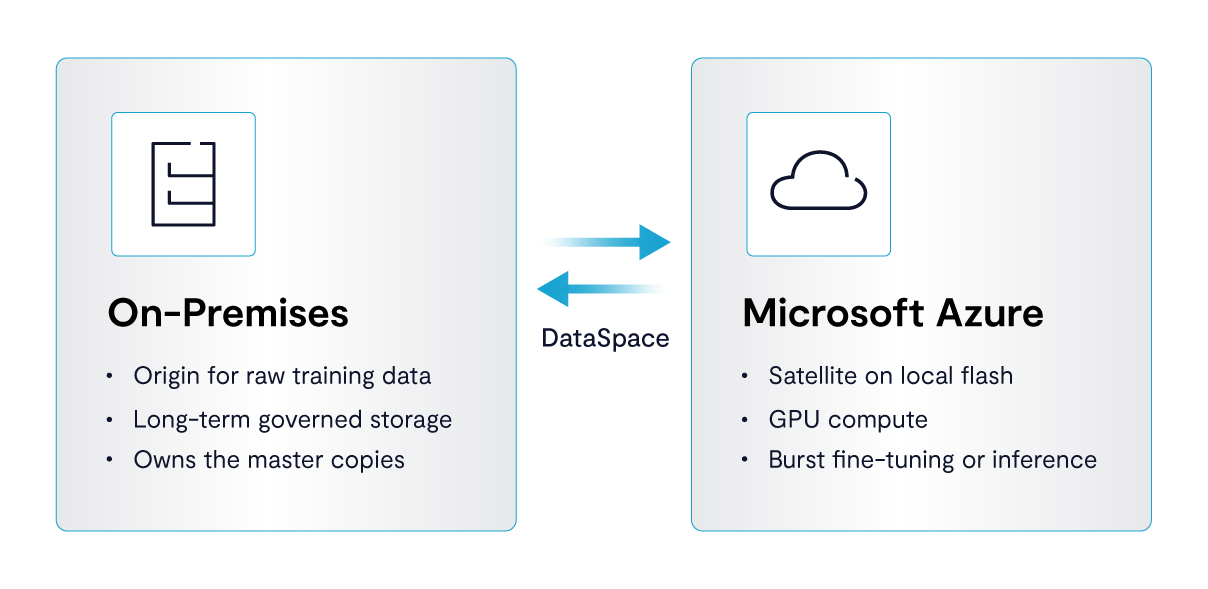
VAST DataSpace provides another approach. DataSpace allows governed access to business-relevant content across VAST deployments in the data center, edge locations, and Microsoft Azure without having to replicate or migrate data. Data stored on a VAST cluster in the data center can be marked as a global folder and made accessible to a satellite cluster in Azure.
The VAST on Cloud satellite cluster:
- Serves the data to local applications.
- Caches frequently accessed data in its own VAST DataStore.
- Fetches or prefetches data based on access patterns instead of copying a whole file or dataset up front.
Advanced read/write leases guarantee strict consistency, ensuring your Azure AI services are always using current, governed enterprise data for training and reasoning.
2. Uncompromised Availability and Durability
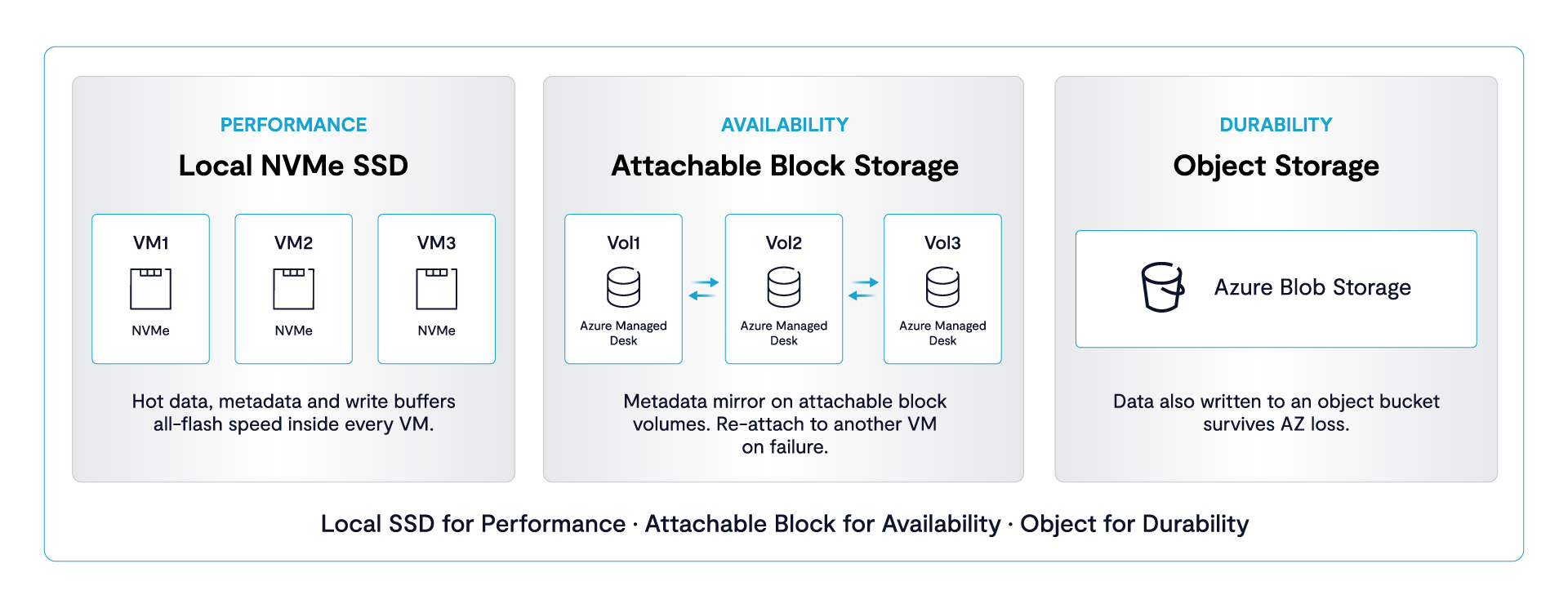
VAST on Cloud for Azure implements Cloud-HA (High Availability) mechanics designed to balance all-flash speed, instance availability, and regional durability:
- Performance (Local NVMe Disks): All data, metadata, and write buffers reside on local NVMe disks within each VM. VAST on Cloud applies erasure coding across all the NVMe drives across the cluster to protect against disk or node failure.
- Availability (Azure Managed Disks): VAST on Cloud mirrors metadata and write buffers to Azure Managed Disks. If an underlying VM fails, the managed disks reattach to a healthy instance to preserve cluster state.
- Durability (Azure Blob Storage): Newly written data streams continuously to Azure Blob Storage. This decoupled object layer protects against Availability Zone (AZ) outages and enables cluster hibernation.
3. Improving Cloud Storage TCO
For Microsoft Azure deployments, decreasing the physical storage footprint significantly improves total cost of ownership (TCO). In addition to compression and deduplication, VAST uses Similarity-Based Data Reduction to identify data that is substantially similar even when not identical, delivering significant capacity savings.
Similarity-Based Data Reduction breaks data into variable-sized chunks, averaging 16 to 64 KB, and uses strong hashes to find exact duplicates. Similarity hashes then identify chunks that share much of their data even when they are not identical. For a similar chunk, VAST reuses the compression dictionary from a reference chunk and stores only the difference, not another full copy. This finds reductions that ordinary deduplication misses, where a small change makes an otherwise similar block look unique. As a result, organizations can store multiple petabytes of flash data in a fraction of the raw cloud disk capacity.
4. A True AI Data Platform (More Than Just Storage)
VAST on Cloud for Azure consolidates your storage silos, but it also goes much further. VAST InsightEngine is a framework that unifies three product capabilities: VAST DataStore, VAST DataEngine, and VAST DataBase. VAST DataBase adds an analytical database for structured and vector data, while VAST DataEngine and VAST Event Broker support event-driven processing. It automatically triggers pipelines, tracks data lineage, and executes AI functions the moment data lands, simplifying how you orchestrate and scale RAG workflows.
In Microsoft Azure, InsightEngine serves as the AI Data Platform that reduces the number of isolated tools needed to support your AI data pipelines.
5. Enterprise-Wide Fleet Management
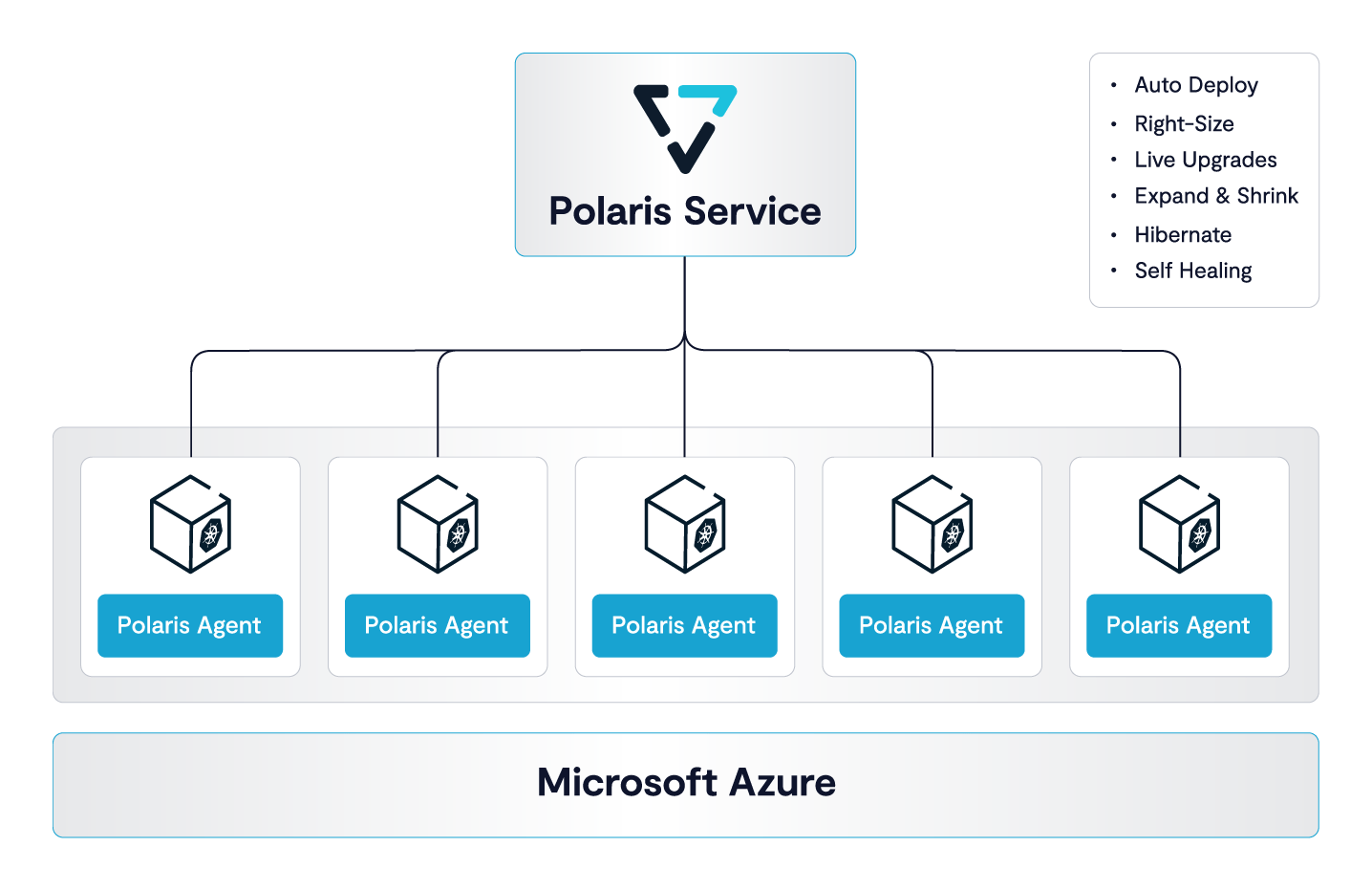
Managing distributed environments shouldn't require disjointed tools. VAST Polaris provides a centralized, automated control plane for all your VAST clusters. Whether your infrastructure is on-premises or deployed in Azure, Polaris handles automated provisioning, live upgrades, self-healing, and right-sizing from a single pane of glass.
Give Azure AI Services a Single Source of Truth
Your AI is only as good as the data behind it. VAST on Cloud brings VAST AI OS into Microsoft Azure, providing a unified platform for file, object, table, and vector data. VAST DataSpace extends access from the data center to Azure, ensuring data remains where it makes sense while making it accessible to cloud-based workloads. And Polaris pulls it all together, providing centralized management of distributed VAST clusters.
Microsoft Azure services, like Microsoft Azure's Foundry Models, get a single source of truth without compromise.
Stop by Booth #1668R at Microsoft Ignite, where you can discover more about VAST on Cloud for Microsoft Azure!