Coding Agents Are Breaking the Cloud’s Biggest Compromise

A developer finds a promising new library or a specialized agent that catches security vulnerabilities. It looks like a better way to build the application. Then comes the familiar question: Do we already support it?
There's a good reason to ask. Every new technology has to be evaluated, integrated, and maintained. A team may decide that a marginal improvement isn't worth introducing something else for everyone to learn and support. Over time, the technologies an organization knows how to manage can become more important than the ones best suited to a particular problem.
Coding agents are changing that calculation. And their impact on how quickly developers write code may turn out to be only part of the story. Coding agents may give developers back some of the freedom that increasing technological complexity had gradually taken away.
How We Got Here
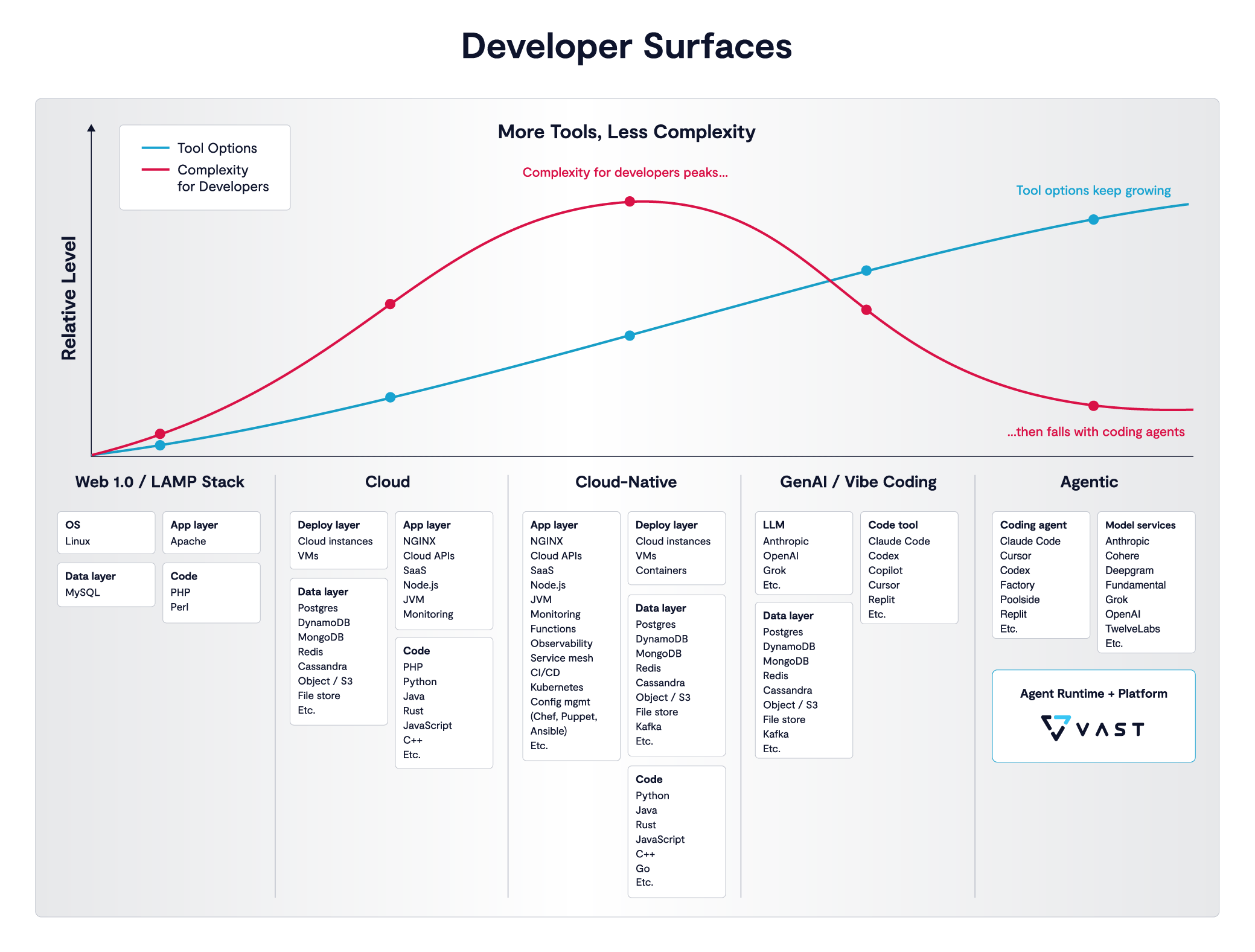
When I started building web applications, the choices were relatively manageable. Linux, Apache, MySQL, and PHP or Perl could support an extraordinary range of projects. The LAMP stack had limitations, but its components worked well together, and developers could understand most of what was happening from top to bottom.
Cloud computing brought an explosion of options. Developers gained managed services for databases, messaging, analytics, and application delivery. Containers and microservices made it possible to assemble applications from independently deployed components. The possibilities expanded enormously, and so did the number of decisions required to build and operate an application.
Every additional service came with APIs, configuration, security requirements, and failure modes. Organizations responded with platform engineering, infrastructure as code, and standardization in order to handle the growing set of possibilities. It wasn’t enough. These practices made complex systems more supportable, but the tradeoff was to constrain choice. A team could find a tool that was better for its application and still have good reasons not to adopt it.
That trade-off has shaped software development for years. We've made more technology available than most teams can practically use.
Moving Up Another Layer
Increasingly, developers work through coding agents. They describe what an application needs to do, set constraints, provide access to the codebase, and review the results. The agent can examine unfamiliar code, implement changes, run tests, investigate failures, and revise its approach.
In my earlier article on the CAMP stack, I described four surfaces that now shape AI application development: Coding agents, Agent runtime, Model services, and Platform. The coding agent is becoming the developer's interface to much of the work that happens across the stack.
What’s interesting is how this abstraction changes the decisions developers can make. Unfamiliar technologies become much cheaper to evaluate and adopt.
Imagine a team considering a library written in a language its developers rarely use. A coding agent can examine the documentation, prototype the integration, run representative benchmarks, inspect dependencies, and create tests. The team can judge a working implementation and decide whether the dependency is worth keeping, without first becoming experts in the new technology.
The same applies to the growing ecosystem of development agents. Suppose a new code-review agent claims to find concurrency bugs that conventional tools miss, or a security agent promises better vulnerability detection. A coding agent can help trial it against previous pull requests, evaluate the findings, and integrate a useful tool into the team's review process. It can also maintain that integration as the tools change.
Developers can also choose among coding agents themselves. Different agents may be better at different tasks, just as different models are suited to reasoning, vision, speech, or other workloads. With fewer barriers to trying something unfamiliar, the choice becomes more closely tied to the work that needs to be done.
It's a surprising consequence of a technology developed primarily to help produce software.
What That Means for the Business
Consider an application for field service technicians. A technician photographs a damaged machine, and the application identifies the component, finds the relevant maintenance procedures, checks service history and parts availability, and creates a work order.
The application might use a vision model to interpret the photograph, semantic search for the maintenance documents, and an agent to decide what needs to happen next. Its developers should be free to evaluate the models and software libraries that work best for those tasks. A specialized testing or security agent might improve the quality of the software as it evolves.
Although developers must build the application and operations teams must support it, what ultimately matters is the impact on customers.The customer likely doesn’t care at all about the underlying technology. The customer cares whether the technician gets the right answer and the repair happens sooner. If a new vision model reduces incorrect part identification, it may prevent repeat visits. If a different retrieval library produces more reliable answers from maintenance documents, technicians spend less time searching.
Coding agents allow the development team to investigate those improvements with less effort consumed by unfamiliar tools.
For organizations with hundreds of applications, the cumulative benefit could be substantial. Teams can experiment sooner, incorporate improvements more often, and tailor applications more closely to the work they perform.
The Complexity Still Has to Live Somewhere
That’s not to say standardization is a bad idea. Anyone who’s spent enough time around production systems can appreciate the consequences of letting every team adopt its own infrastructure. Trying to remember another database's SQL dialect while troubleshooting a failed application at 02:00 isn't much fun. A coding agent can help diagnose the problem, but someone still has to keep the system running.
In the months and years to come, however, savvy teams will embrace the flexibility that coding agents make possible, while being much more deliberate about the infrastructure underneath.
Returning to our field service application, imagine technicians begin recording spoken notes or short inspection videos. Deepgram provides speech recognition capabilities, while TwelveLabs offers Marengo for video embeddings and search, and Pegasus for deeper video understanding. A coding agent can help integrate and evaluate those capabilities, allowing the application to evolve without requiring its developers to specialize in each new model.
The trick is pulling it off without traditional infrastructure sprawl. Cost controls discourage unnecessary copies of data, and security policies restrict movement across trust boundaries. These are sensible constraints, especially when dealing with sensitive enterprise information. As developers gain more freedom to choose their tools, the ability to use those tools against existing data, without repeatedly moving or duplicating it, becomes increasingly important.
If I were building this application on VAST:
- I'd store photographs, videos, and maintenance manuals using S3, with NFS access to the same data for existing applications that need it.
- An S3 object-created event could publish to a Kafka-compatible stream, triggering a Python function to extract metadata and generate embeddings.
- I'd store the metadata and vectors in SQL-accessible tables, enabling the combination of similarity searches with structured queries when trying to find the right maintenance instructions.
- An agent runtime would coordinate the investigation, check service history, and use the existing work-order API to create the ticket.
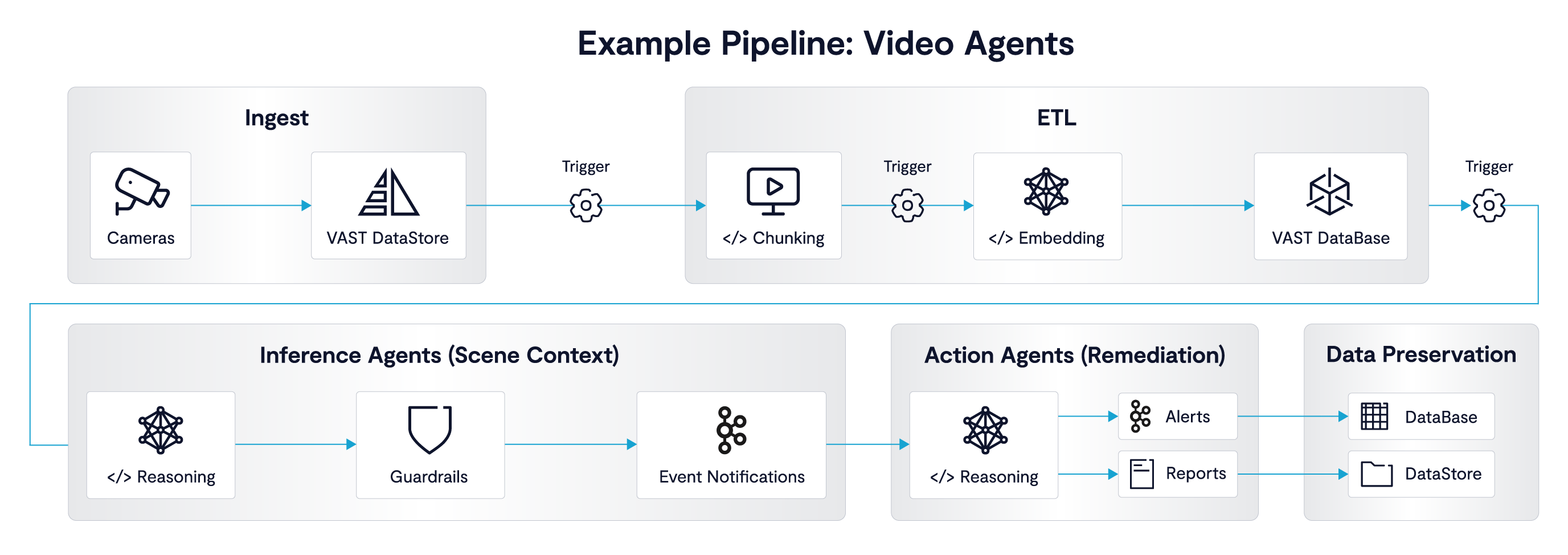
Underneath these capabilities is a deliberate architectural choice. We built the VAST AI Operating System to provide S3 and NFS access, SQL and vector search, Kafka-compatible event streaming, and Python-based processing on a shared data foundation. Agent runtimes can operate against that same information without each application needing its own collection of databases, queues, and security policies.
That becomes especially valuable as applications change. If the field service team adopts a better vision model next year, or adds video understanding, its underlying data and application state can remain where they are. Existing applications that still use ordinary files and SQL can continue operating alongside newer ones using vectors and autonomous agents.
The number of useful coding agents, models, and development tools is only going to keep growing. For developers, the next abstraction layer makes that variety increasingly practical to test and adopt. Take advantage of it. Experiment with the technologies that make your applications better, but be disciplined about the infrastructure that supports them.
The more freedom we give developers at the top of the CAMP stack, the more important a dependable foundation becomes underneath.