AI Factories: The Infrastructure Behind Modern Intelligence
To stay competitive, today’s enterprises need Operational AI that extends beyond insights to rapid, meaningful action. And the key to getting there is an efficient AI factory — not just a physical engine for token generation, but an entire production system that makes those tokens reliable and useful for a business. So, how do AI factories work? And why are they needed? Read on to learn how leading cloud providers and enterprises are leveraging AI factories to accelerate revenue generation from AI.
Maximizing Efficiency and Productivity in Operational AI
An AI factory is an end-to-end production system for Operational AI, built to reliably produce business-ready intelligence a company can act on.
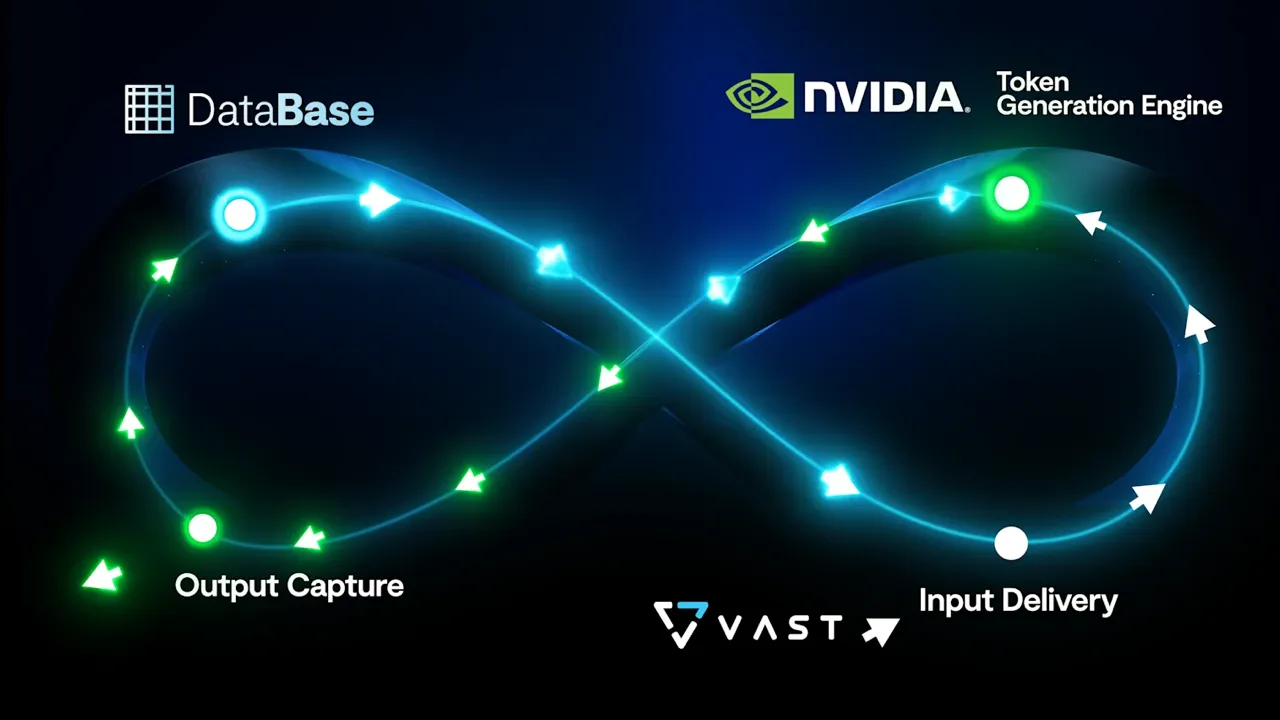
It combines two interlocking flows: a token generation engine, powered by NVIDIA that handles model training, fine-tuning, and inference; and a context supply chain, powered natively by the VAST AI OS, that feeds enterprise knowledge into the engine at the right moment and captures what it produces to improve over time.But generating tokens quickly is only half the job. To deliver real enterprise value, an AI factory has to be built for maximum efficiency. That's where many fall short: every component of the token generation engine and context supply chain must be expertly connected and orchestrated to minimize lag and maximize useful output.

The Need for a Next-Generation AI Training Infrastructure
According to Deloitte, over 90% of AI proof-of-concepts never scale. With many enterprises having experienced this firsthand, they are now increasingly pursuing the AI factory model over attempting to retrofit existing infrastructure — whether that means leveraging an AI Infrastructure-as-a-Service (AI IaaS) or building their own AI factory from scratch. Here’s why:
Performance Demands
Traditional infrastructures served their purpose well for basic data storage and recall, but AI workloads have shifted data demands into overdrive. With data constantly in motion, legacy file systems struggle to keep up. However, with their massively-parallel, all-flash storage structure and context supply chain to handle real-time data feeds, AI factory infrastructures readily support the low latency that AI token generation engines require.
The Urgency of Scale
Increased data demands yield exponentially greater data volumes, causing traditional systems to quickly reach their limits when used for AI applications. Given the current speed of AI innovation happening in nearly every industry, enterprises simply can’t afford to have their efforts throttled by inadequate technology. AI factory architecture is built to handle exabyte-scale storage and data processing that keeps up with any and every AI initiative.
Margin Preservation
AI data centers require significant investment in expertise and technology. Attempts to reduce up-front costs by retrofitting existing infrastructure for AI purposes almost always lead to greater spend down the road in the form of poor model performance and required system overhauls. Enterprises that invest in a proper AI factory system from the get-go are better positioned to build scalable AI initiatives that create and preserve healthy profit margins.
What It Takes to Run AI Factory Architecture at Scale
At the heart of an AI factory is a token generation engine for training and inference. To turn tokens into business value, it must be supported by a context supply chain that orchestrates the entire AI factory process.

Data Intake
Enterprise context lives everywhere: files, objects, databases, logs, and streams across the business. A context supply chain is an always-on intake layer aligning real-time ingestion, data prep, and AI storage in one platform for model training readiness.
A context supply chain acts as an always-on intake layer that aligns real-time data ingestion, preparation, and enterprise AI storage capabilities into one platform for model training readiness.

Input Delivery
A context supply chain makes prepared data inputs easily accessible to the token generation engine. Fast lookups and vector-aware retrieval deliver enterprise knowledge at just the right moment, while live streaming flows refresh indexes as data changes.
Fast lookups and vector-aware retrieval capabilities deliver key enterprise knowledge into the run at just the right moment, while live streaming flows continuously refresh indexes as data changes.

Data Governance
Context is only useful if it's used safely. A context supply chain applies access policies and traceability logging as inputs are prepared and retrieved, so the AI system respects who can see what and leaves an auditable trail back to the source.
This allows the AI system to respect who is allowed to see what, and leaves a trail back to the source material so teams can understand what it used.

Output Capture
Inference outputs are not the end of the AI factory process. The model’s actions, decisions, summaries, and artifacts become valuable context for future work.
A context supply chain captures and curates these outputs, turning them into reusable enterprise knowledge that gets fed back into the AI process.
AI-Native Infrastructure That Creates a Continuous Intelligence Loop
A highly-efficient AI factory needs a robust production engine (powered by NVIDIA) with an intelligent context ecosystem around it (powered by VAST). Together, these two flows create an end-to-end process that’s optimized for Operational AI — one that’s not just fast, but also reliable, productive, and governed.
Why Organizations Struggle with AI Factory Efficiency
Building an efficient and productive AI factory from scratch is hard and expensive. Here’s where many enterprises get stuck:
Context Recency
Context Recency
Enterprises are capable of generating tokens at remarkable scale, but sophisticated Operational AI that produces true business results requires more than just pre-training knowledge or small, curated datasets as inputs. For meaningful impact, AI models need to be kept up-to-date with living, real-time information that changes continuously with the business. However, this critical upstream context is often stale, fragmented, or inconsistently processed — resulting in token generation that, while still fast, steers the model’s inference output further away from the enterprise’s current reality.
Multiple Systems
Multiple Systems
One of the biggest hurdles that enterprises and cloud service providers (CSPs) face when building AI factory architecture is managing separate systems for storing, processing, and retrieving the data needed for AI training. Most traditional data infrastructures lack the parallel performance needed for AI development, so data must continuously be copied or transferred between systems to perform tasks — creating lag in the network and hindering AI model inferencing performance. At times there can also be the need to connect to other factories or GPU data centers for multi-cloud AI support, but the federation capabilities to form a secure, unified network are commonly missing.
Data Management
Data Management
An AI infrastructure requires massive amounts of data storage and throughput, at levels most organizations have never before seen. The magnitude of these data handling requirements often gets underestimated in the planning phase of an AI factory, leading to bottleneck issues in the AI data pipeline later on. Additionally, enterprises sometimes fail to account for proper data provenance, leading to difficulty with explainable AI.
Oversight & Governance
Oversight & Governance
AI factory operators typically have software in place to manage each individual phase of the process, but lack a high perch from which to view the entire factory floor and monitor end-to-end progress. Without this centralized viewpoint, errors and inefficiencies can creep into the pipeline and negatively impact model inferencing later on. On top of that, the absence of a comprehensive AI governance layer jeopardizes the enterprise goal of creating a secure AI factory — creating inference log and data privacy gaps, and putting regulatory compliance at risk. VAST’s PolicyEngine addresses this by enforcing inline governance and tamper-proof audit trails across every AI interaction, so operations stay observable and compliant end-to-end.
Output Capture
Output Capture
To strengthen a model’s future performance, its outputs, decisions, and new artifacts should flow back into the AI factory environment as new context that the business can reuse — especially when the outputs are deemed to be of high quality. However, so often these outputs aren’t captured at all, or are captured in ad hoc silos. When this occurs, the AI system is unable to compound its learning, and teams end up repeating the same preparation work in every application. VAST’s TuningEngine is built to close this gap enabling improved models through a continuous improvement flywheel, so the factory gets smarter with every run.
Resource Allocation
Resource Allocation
AI factories are still a relatively new concept, and each use case can have vastly different requirements. Therefore, there’s no one-size-fits-all blueprint for how exactly an AI factory should be built. Without proper guidance, organizations can find themselves overbuilding, overspending, and misallocating compute and/or monetary resources to parts of the AI factory infrastructure that don’t have a meaningful impact on the overall efficiency and output of the factory.
All-in-One AI Factory Orchestration
VAST helps enterprises and cloud providers move beyond stitched-together solutions and align AI factory operations in one platform.
VAST AI OS
The VAST AI Operating System (VAST AI OS) is the infrastructure that enables the factory’s context supply chain. It’s the critical orchestration layer of the operation — automatically ingesting, preparing, and distributing data to keep a token generation engine fueled with the inputs needed to create highly useful intelligence.

One Unified Platform
Rather than relying on a DIY duct-taped solution, VAST provides organizations with an all-in-one enterprise AI platform to manage and orchestrate all AI factory stages — plus a single storage tier that natively supports any AI training data format (file, object, table, or block).

Exabyte-Scale Throughput
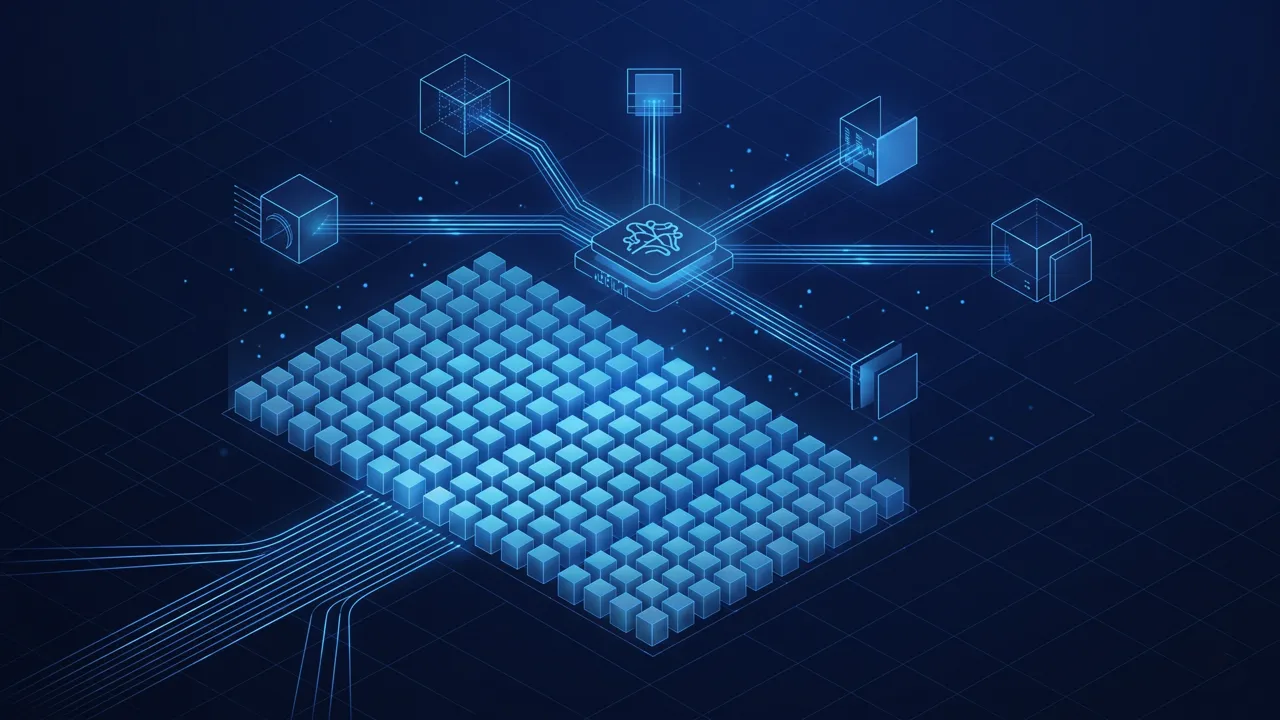
VAST’s Disaggregated, Shared-Everything (DASE) architecture — with all-flash, parallel data storage — does away with the common thresholds of legacy data systems and enables the construction of AI factory infrastructure that features real-time data ingestion, exabyte-scale storage, and ultra-low latency.
Global Availability
VAST’s AI factory platform provides organizations with one global namespace and worldwide system availability without needing scheduled downtime. It also offers federation capabilities that allow geographically dispersed GPU data centers to connect and function as a single factory.

TuningEngine
Most AI systems are static between deployments — they don’t learn from what they produce. VAST’s TuningEngine, slated for release by end of 2026, closes that loop by enabling outcomes from agentic pipelines to be used as curated feedback to automatically suggest and benchmark improved candidate models. Each new model can be deployed manually or automatically, so the factory gets smarter with every interaction — no manual rework required.

Powering the World’s Most Advanced GPU Clouds
VAST AI OS enables advanced context supply chains for GPU data centers in the AI era — designed to deliver optimal scale, performance, security, and operational efficiency for cloud service providers and their customers. In an industry with tight margins, CSPs can’t afford to operate on platforms that create downtime, and their enterprise clients can’t afford to waste resources on constant AI platform administration.
VAST solves this with its Disaggregated, Shared-Everything (DASE) architecture, which combines storage, database, and compute into one scalable AI Operating System. With VAST, CSPs can power AI and deep learning services while keeping operations streamlined — shifting the focus to delivering exceptional customer experiences.

Build Your AI Factory on VAST
Whether creating the next AI cloud or tackling large-scale internal AI development, build your AI factory infrastructure on the platform trusted by the world’s leading enterprises and CSPs. VAST adds essential automation, visibility, and compliance to your token generation efforts, creating a continuous context supply chain to greatly improve your factory’s productivity and business value.
Schedule a demo with our team today, or continue reading about VAST AI OS.