Following our recent announcement of a $30 billion valuation, I’ve received a surge of interest from my professional and personal networks alike asking a fundamental question: “What does VAST Data actually do, and why is it essential for the AI era?”
The short answer is this: VAST builds the operating system that companies use to build and run AI models and applications at global scale.
And while the valuation reflects our growth, the real story lies in the “plumbing.” Most enterprise AI projects fail not because the models are inadequate, but because the underlying infrastructure collapses under the weight of modern data demands. VAST was built to ensure that doesn’t happen.
The Problem: The AI “Tax” of Complexity
To understand VAST, you first have to understand the bottleneck of traditional infrastructure. AI is not a single task; it is a continuous pipeline of training, fine-tuning, and inference. In the most common IT environments the data required for these stages lives in disconnected silos, be it call transcripts, contracts, videos, or logs scattered across disparate systems.
To try to make this data useful, organizations have stitched together a complex stack of technologies: object storage for raw data, ETL pipelines for movement, data warehouses for structure, and vector databases for semantic retrieval.
This stack cannot satisfy AI’s requirements for scale, performance, and freshness without introducing massive inefficiencies. Every pipeline becomes a “tax,” every copy a potential privacy or security liability, and every synchronization step a potential failure point. At the heart of this struggle is the constant movement of data: shifting it from storage to compute, or from batch pipelines into real-time systems.
Instead of rethinking the architecture - like VAST did - vendors responded by adding more components, more layers, and more systems that must constantly struggle to agree on what the data actually is. And as you’d expect - complexity compounds, latency increases, and costs spiral. In the AI era, the old “best of breed” approach has officially become a liability.
The Solution: The VAST AI Operating System
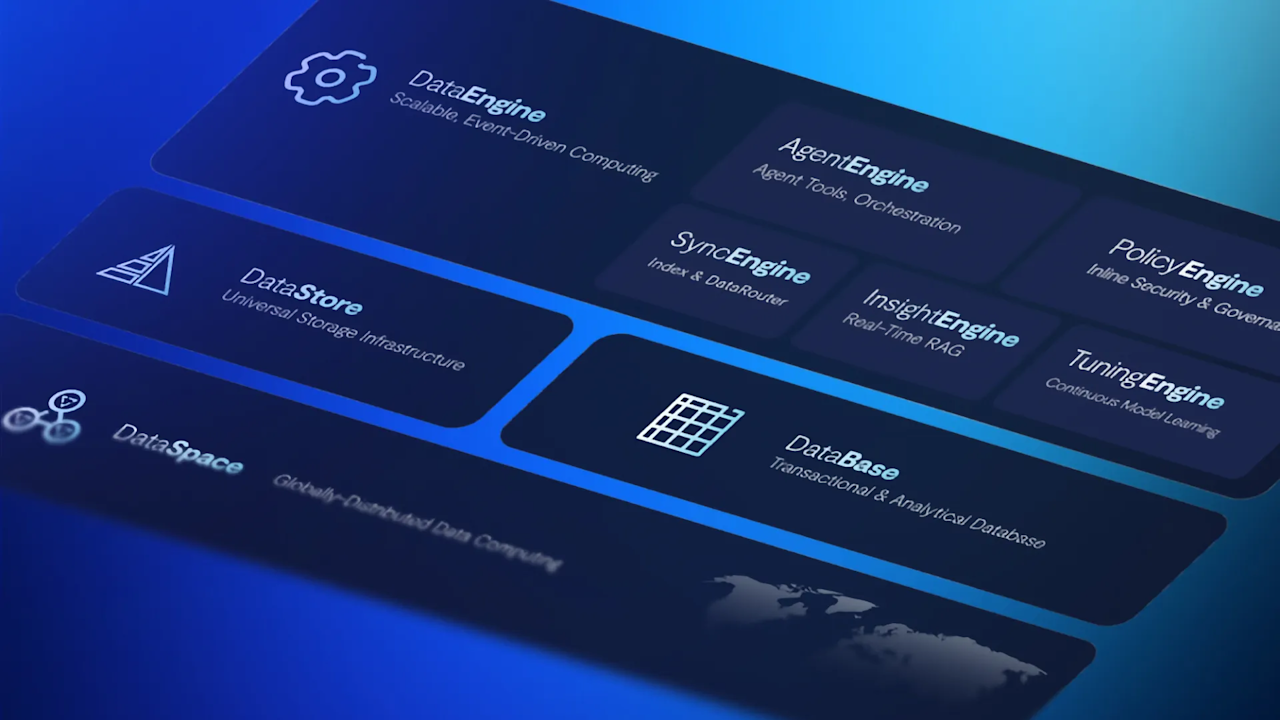
VAST collapses these disparate layers into a single, cohesive platform, or AI Operating System. We have replaced the “stitching together” of products with several core engines that work in harmony:
DataStore: the storage foundation for files, blocks, objects, tables, streams - all your data - at exabyte-scale with six nines of availability
DataBase: the query engine combining the best aspects of traditional data warehouses, modern data lakes, and high-performance computing
DataSpace: the global data fabric that treats data across many data centers, cloud regions, and edge sites as one logical namespace
DataEngine: the activation switch for AI data pipelines, providing event-driven compute where the data lives. An engineer writes ‘when a new PDF lands, extract the text and update the index’ and the system handles it.
SyncEngine: an automated data discovery and indexing tool, pulling new data into the AI OS continuously.
InsightEngine: an all-encompassing ingest, index, and search system that converts data into vectorized formats, ensuring models always have access to real-time, relevant context
AgentEngine: Provides a safe, production-ready runtime for AI agents - software that takes action rather than just answering questions - handling the necessary credentials, audit trails, and guardrails.
The point is not that one engine wins every beauty contest. The point is that seven of them on one foundation, with one security model and one set of interfaces, add up to something a stitched stack cannot match.
(Underpinning all of this is the revolutionary DASE architecture. This modern systems architecture eliminates the traditional trade-offs between performance and scale, and while it’s the key to everything we do, I’ll dedicate an entire separate blog post to explaining its full depth.)
Why It Matters Now
Here are my three practical implications for a non technical leader:
Treat “data plumbing” as a foundational strategy Without a clean, robust data layer, impressive AI demos remain just that. The team owning data plumbing essentially controls the ceiling of your AI ambition. Investing in resilient, high-performance data infrastructure is a strategic prerequisite, not an IT cost.
Beware the Integration Tax Ten “best of breed” point products plus a team of integrators is usually slower, more fragile, and more expensive than one good platform. Perceived savings vanish, replaced by costs from duplicate data, bugs, security gaps, and complexity. Simplicity and unification accelerate AI deployment.
Agents are the next management problem AI’s next evolution involves agents actively performing tasks. This introduces critical operational concerns: permissioning, accountability, audit trails, and supervision. Organizations must establish a governance framework now, defining where agents reside, who supervises them, and how to safely and quickly roll back errors. Agent governance is a core executive concern.
Our founders posit that the next decade of software will feel a lot like the decade after Windows: a wave of new applications built on top of a common foundation.
Most people will not hear the name of that foundation. They will just notice that their bank is easier to deal with, their hospital caught something earlier, their retailer had what they needed, and the people they dealt with seemed a little less hurried. That is the version of AI worth building. It only exists if someone does the tedious work of rebuilding the plumbing underneath.
At a $30 billion valuation, VAST is no longer just a “storage company” but the company providing the plumbing of an entirely new wave of data infrastructure.


