Today, we announced that VAST Data is now valued at $30B, establishing the company as the most valuable private data infrastructure software company in history. This new Series F round was led by Drive Capital and included many of the world’s most respected infrastructure investors, such as Access Industries, NVIDIA, Fidelity Management & Research Company, NEA, and more. Between the primary company investment and secondary sales of VAST stock, this round represents nearly $1B of investment and welcomes VAST into an elite circle of next-generation companies who’ve found product-market fit in the $100T AI market that has emerged seemingly overnight. Given this unique position in the market, I thought I would take a moment to provide some perspective on how we’ve gotten here. To start, it’s fair to say that VAST is working hard to build a generational company at the center of the data and AI revolution. From our perspective, generational companies share three fundamental qualities:
They build products that are 10x better than previous approaches
They address a market disruption that causes customers to abandon status quo
They out-execute, turning product-market fit and timing into a sustainable business
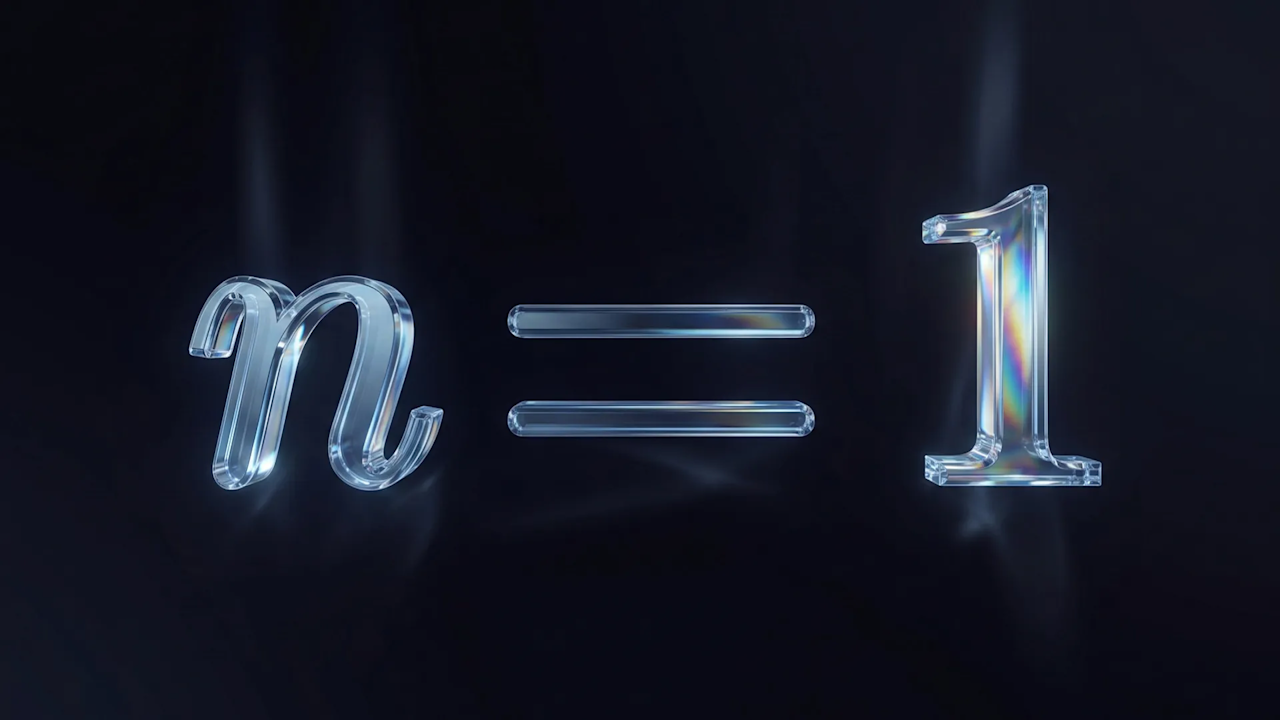
Unsurprisingly, these qualities combine to create the foundation of the VAST story and the thesis of our long-term potential. It turns out this mix is very hard to perfect, and as we were working through the investment and sharing our story to some of the most respected technology investors, we kept hearing back from them the same phrase … “N=1”. When something is described as “N=1,” it’s a signal that indicates that someone has “never seen anything like this before.” A category of one. Today, I’ll attempt to explain N=1 in terms of both VAST’s business posture, as well as our technology advantage.
N=1: The VAST Data business story
Since the dawn of ChatGPT, VAST Data’s business has grown exponentially. Six years earlier, we started working on a next-generation parallel systems architecture that found itself in the right time and right place when the world discovered the commercial application of deep learning. During periods of exponential growth, nearly every growth story is punctuated by a lack of profitability and significant burn of venture capital. To see examples of this, look no further than today’s AI labs, which are each growing their business like crazy while burning historic levels of venture capital on R&D.
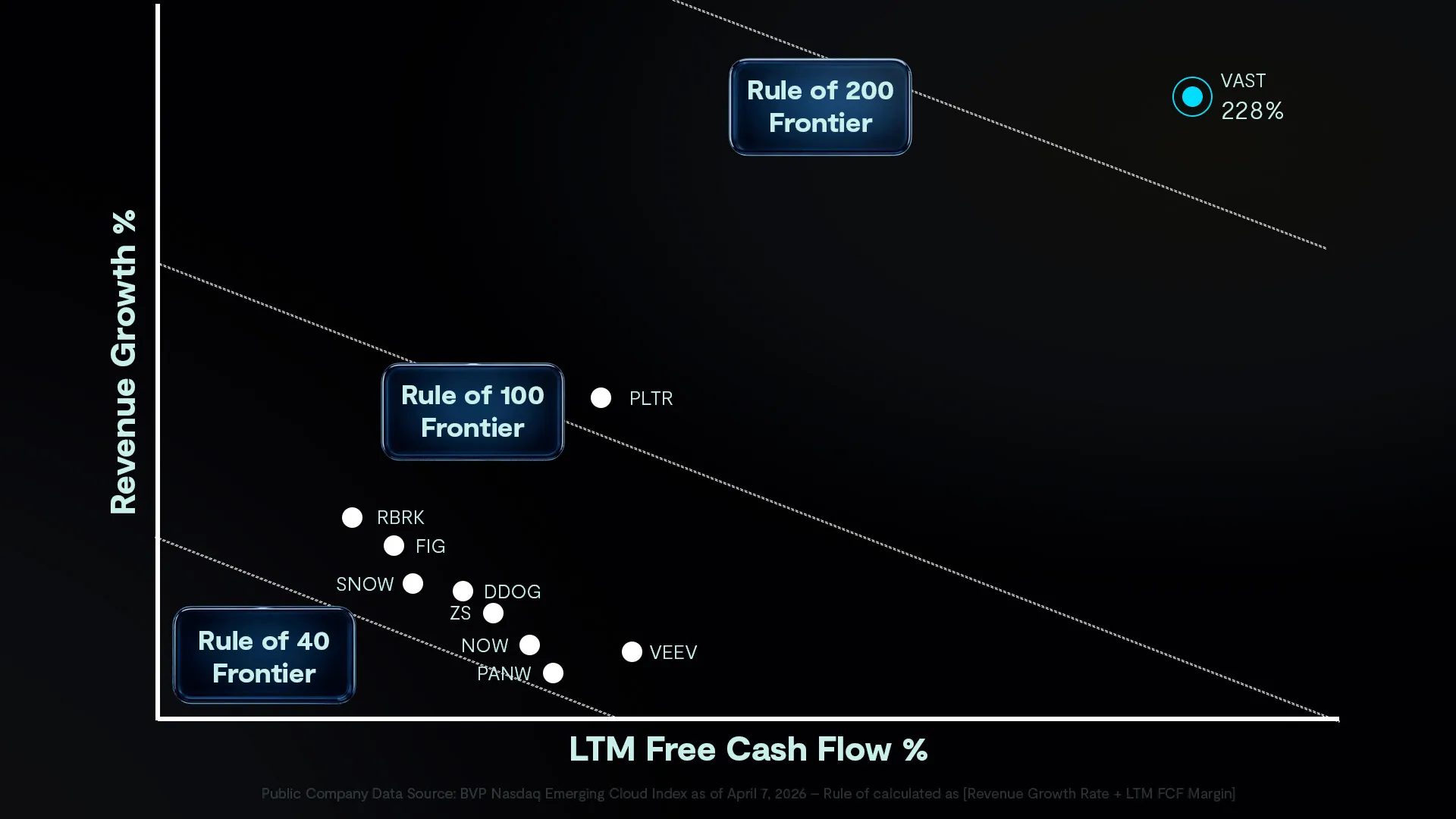
The tradeoff between corporate efficiency and growth is not limited to AI labs. Over the last 40 years, companies have been forced to choose between investing in technology (aka innovation that comes with significant expenses) or investing in a sustainable business (profitable and cash efficient operation). This tradeoff is best expressed in a financial metric that is known in technology circles as the Rule of X. The Rule of X (also referred to as the Rule of 40) is often defined as the sum of a company’s growth and its free cashflow margin, where anything over 40% is considered a healthy and sustainable business. Not surprisingly, there’s a spectrum of performance as companies get measured by the Rule of 40 — where growth can be traded for efficiency or vice versa, but the sum of these numbers is the measure of how promising a business is. If 40% is the benchmark of a “good” company, the best ten $10B+ public software companies (ranked by Rule of X performance) average out to 61%. What excites investors about VAST is our unprecedented mix of growth and profitability, demonstrating to the world that a radically disruptive product and focused team can break fundamental business tradeoffs. Without concern for cash burn, we’ve shown the world that we’ve built a business that can innovate and grow, since our business model is ultimately sustainable.
More succinctly: At 228%, our Rule of X measurement is wholly without comparison. N=1.
Given this, you would be right to ask yourself, “Why did VAST take an investment if it’s profitable and generating cash?” Good question. Just as with the funds that came from our series B, C, D, and E, the money invested into VAST in our Series F will go right into the bank and sit alongside our growing cash reserves while they gain interest. In reality, public financing rounds serve two primary purposes for our company:
Each investment is a public and independent validation of our progress, and serves as a signal to the world that we’ve raised the bar yet again because of the worldwide adoption of VAST’s AI Operating System. Our customers take comfort in the vote of confidence that comes from companies such as Drive Capital, Fidelity, NEA, NVIDIA, and others.
Our ambitions are scaling with our warchest. As our cash reserves scale, we can make meaningful investments that will help our customers get more value from their AI efforts. With well over $1B of cash in the bank, VAST now has the optionality to make strategic investments that can accelerate the market adoption of our AI Operating System.
N=1: The VAST Data AI Operating System story
Once our business success story is appreciated, the natural question is: “Why is VAST able to achieve this breakout business story?" The answer leads people to understand that while we are displacing many legacy competitors across the data center stack, there is no company that offers a product as ambitious, as comprehensive, and as purpose-built for scalable AI workloads as VAST Data. In 2016, we envisioned a future where the computational pressures of deep learning would upend every layer of the data center stack. At the time, OpenAI was just getting off the ground and NVIDIA was just starting to ship the world's first deep learning supercomputer, the DGX. Since then, parallel data processing has been more and more critical to the world’s AI endeavors. To put this into perspective, the AI factories that VAST supports today have over 1 billion CUDA cores or over 1 million tensor cores, all accessing a single VAST data platform.
The infrastructure we support does not stop scaling. As large-scale agency and agent swarms define the next generation of computing, all the world’s data infrastructure will need to stand up and answer the call of this level of parallelism. However, the universal need for scale was not so obvious until reasoning models and agents emerged in 2024-2025, and this was the spark that ignited a global re-platforming of the world’s data systems and has led our customers to conclude that VAST’s AI Operating System is critical to achieving future scaling ambitions.
We’ve been students of the predictions made by Ark Capital for the last 5 years, a firm that took an early stance on the impact of deep learning that is now undeniable. Looking forward, Ark paints a picture where our AI infrastructure investments grow 10x-15x over the next 4 years … much of this infrastructure may be in space, and, yes, VAST is working with partners to build space-based AI factories. That’s a good case for a global namespace, huh? 🙂
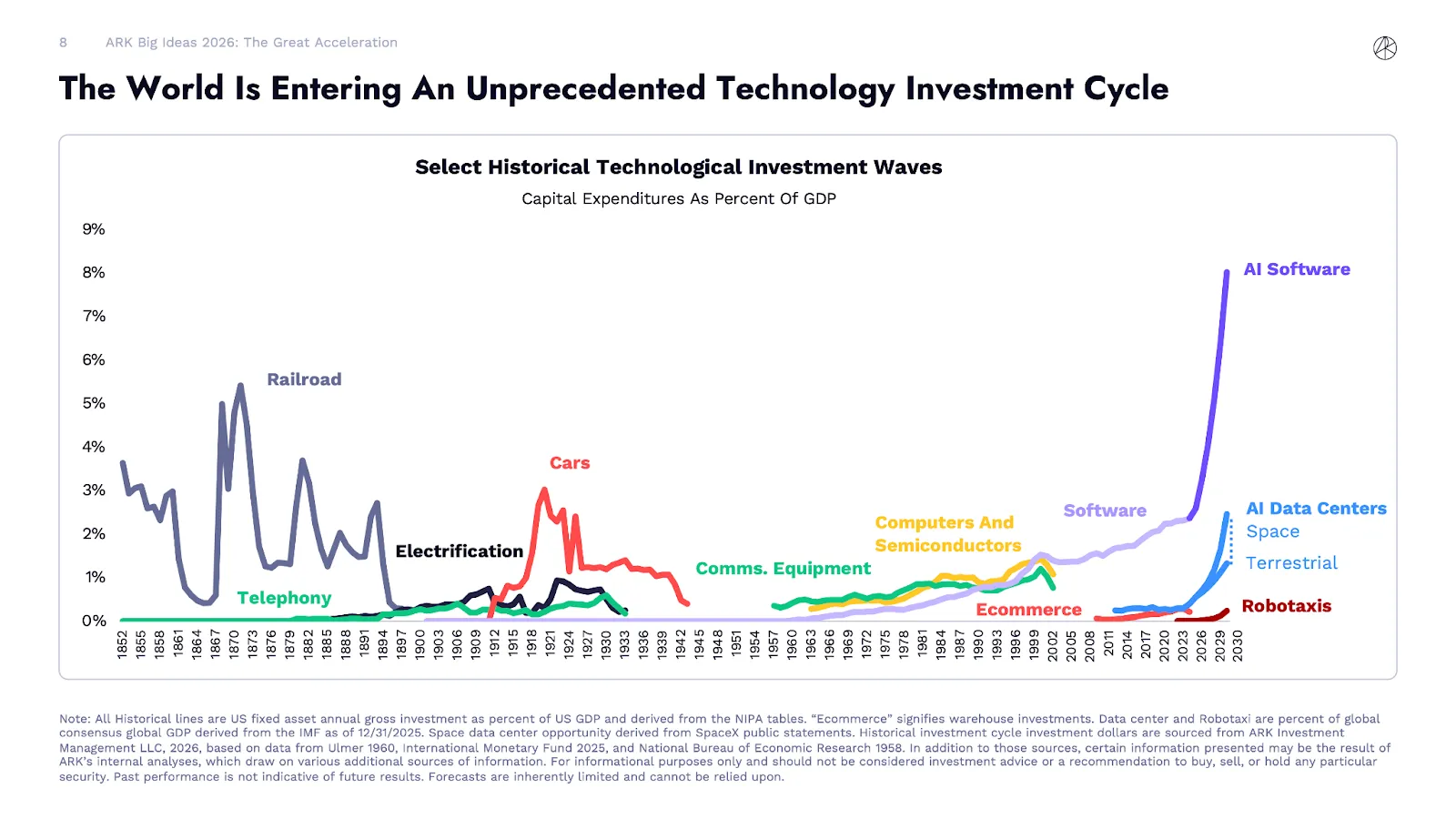
Source: Ark Invest's Big Ideas 2026
Every aspect of the computing stack needs to be reimagined for this level of investment, this level of scale and application parallelism.
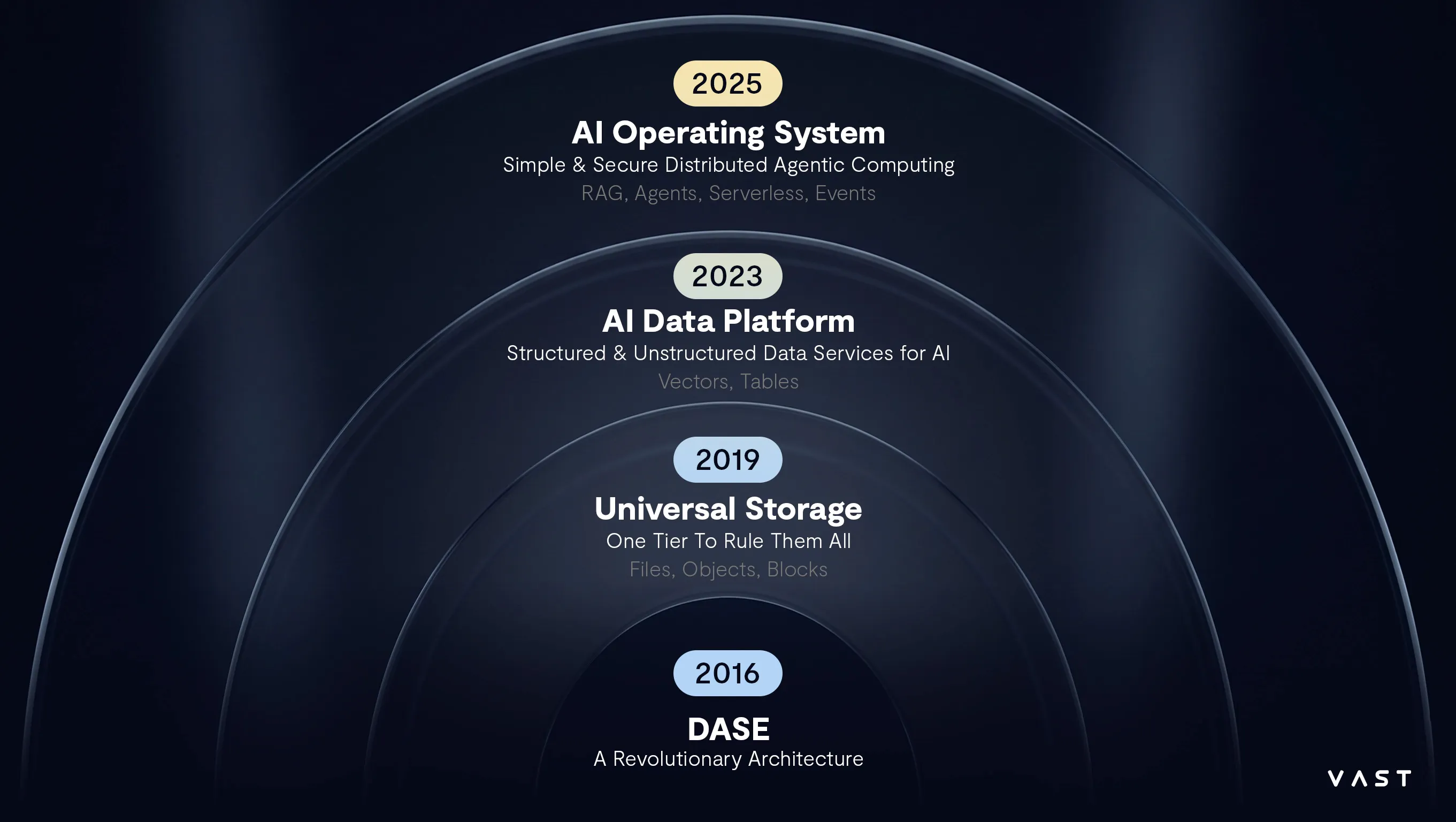
That’s why in 2016 we began work on redefining an altogether new systems architecture, called Disaggregated and Shared Everything (DASE, for short), that is today the foundation for our unified AI system. DASE picks up from the work Google did in the early 2000s, creating a new, more scalable, more resilient, and more affordable blueprint for distributed storage, databases, and computing. DASE is the world’s first “embarrassingly parallel” distributed system. DASE is famous for breaking tradeoffs between performance, capacity, scale, simplicity, and resilience … and it’s the foundation for the data and compute services provided by our AI Operating System.
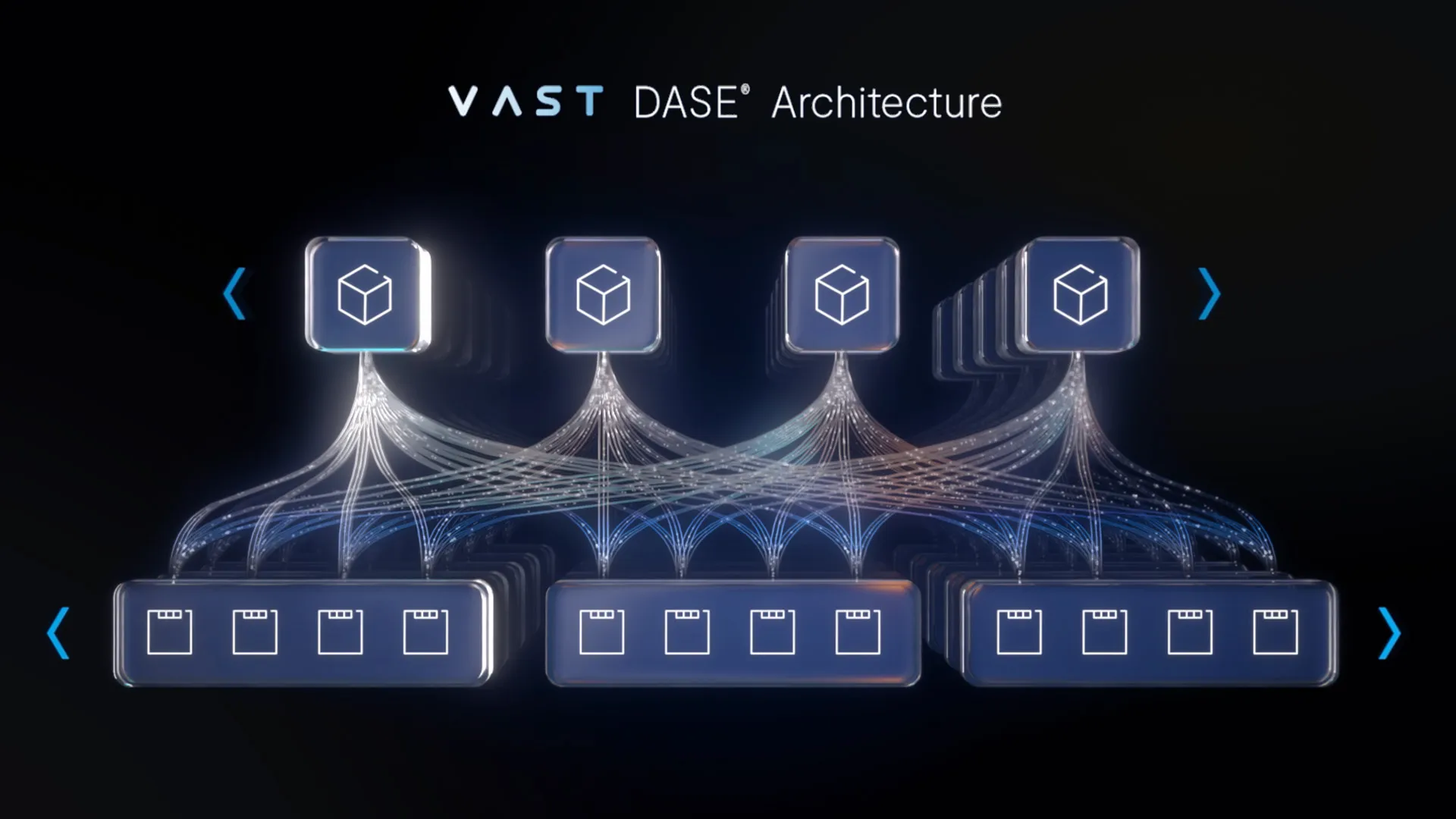
With this foundation built, we then layer on a broad set of capabilities needed for VAST’s AI Operating System to be the essential full-stack computing platform for deep learning:
The VAST DataStore is the first universal storage for all of your enterprise data
The VAST DataBase is the world’s first transactional + analytical data analytics platform
The VAST DataEngine hosts the RAG and agentic workflows that leverage the DataStore and DataBase as resources for real-time AI computing
The VAST DataSpace federates your data and computing environments to provide anywhere-access as well as global compute function routing from edge to cloud
Our DASE architecture is our advantage that creates new capabilities. Our ambition and capability leads us to invent across a number of technology categories. The result is one platform designed to do many things very well: file, object and block storage, events, EDW, vectors, runtimes, agents. VAST is not a category killer. The broad reach of VAST’s AI OS establishes us as a killer of categories. Never in the history of data center infrastructure has a single software stack had this much best-in-class capability. The scale and tradeoff-breaking nature of the DASE architecture makes all of this now practical. N=1.
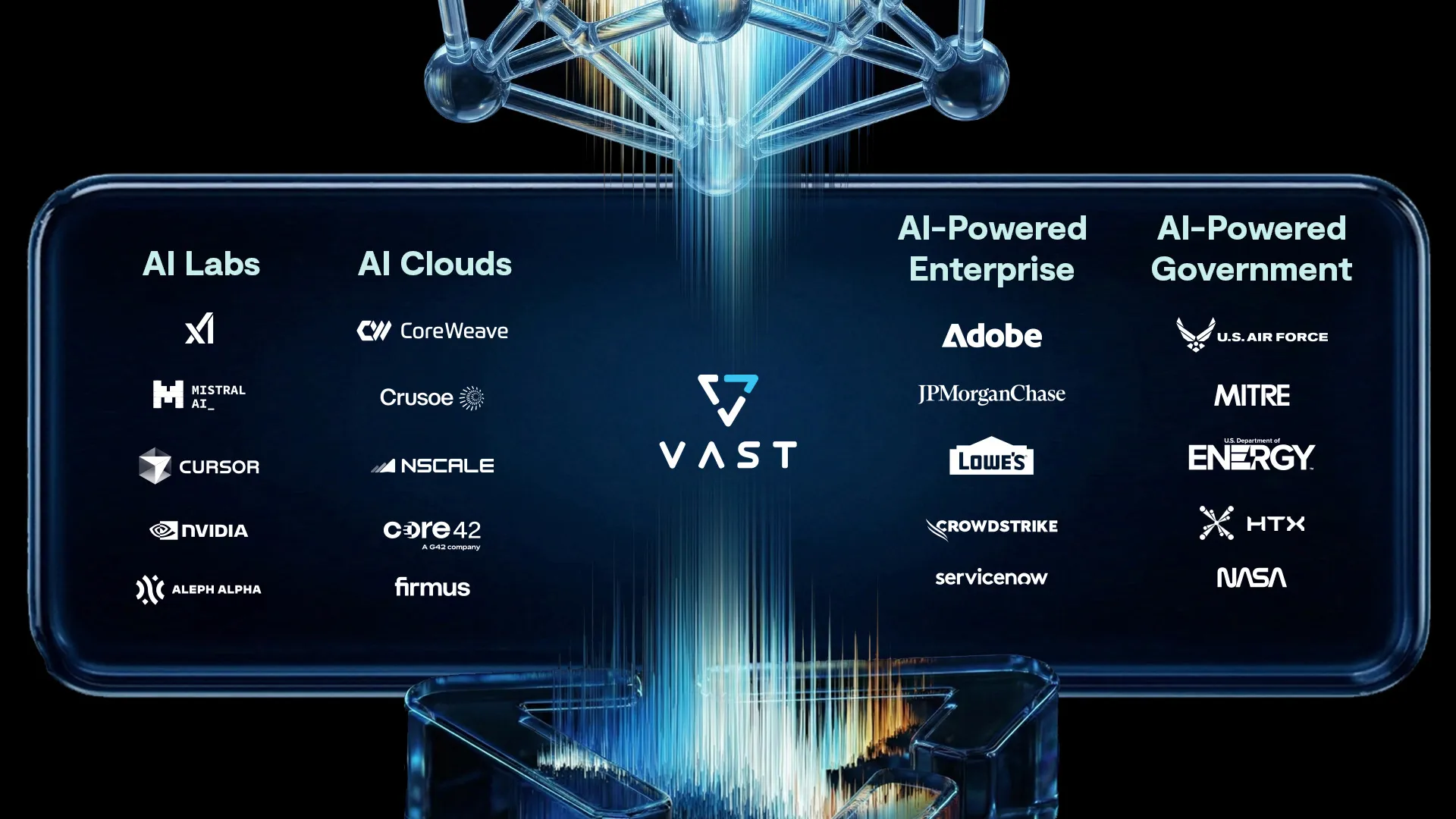
Are we an AI company? Are we an enterprise systems supplier? Yes. VAST thrives everywhere where data and computing collide. Our AI-native and enterprise customers have chosen the AI OS to power over 3 million GPUs around the world. Moreover, our experience at the AI-builder frontier provides us with a unique perspective into the future of AI scaling that we bring to enterprise customer deployments. This duality of our business model is important to us as we work to democratize the deployment and scale of AI in every major market.
Where do we go from here?
Well … we’re just getting started. There’s so much we still need to do just this year:
This year, VAST will start building out AI platforms with leading hyperscale CSPs.
This year, we will engineer zero-trust safeguards into agentic workflows.
This year, we will build fine tuning for AI models into the platform.
We might have one or more clusters deployed in space by the end of the year.
All the while, AI computing will scale by an order of magnitude in just 4 years. 1,000%.
People frequently ask me who our primary competitors are. In some respects, we’re competing with everyone up and down the data center stack. In another respect, our product has no known analog outside of the largest public cloud platforms that have to stitch together dozens of services to rival what VAST can do with one unified system. We are actively working to simplify how the market approaches distributed systems as an altogether new product category - AI operating systems - takes shape. While this N=1 party can seem lonely, we’ve been privileged to be surrounded by the world’s most ambitious and inspiring builders, as both customers and partners. I want to thank everyone who has taken this journey with us so far. The VAST community is growing every day and the collective support and perspective we captured is funneled directly into our work of helping shape the future of computing.


