
As the sports world barrels through one of its busiest stretches of the year, the machinery behind modern sports media is under more pressure than ever. With the MLB season in full swing and the NBA Finals and the Stanley Cup Final underway, modern sports broadcasting increasingly looks less like traditional media production and more like hyperscale data infrastructure. And the old architecture is starting to crack under the weight of it.
The past several decades have seen broadcasters and leagues paper over exploding file sizes with a patchwork of flash arrays, production storage, and tape archives stitched together into sprawling media pipelines. At one point, the National Hockey League was juggling five separate storage platforms just to keep operations moving, the NHL’s Vice President of Media Operations and DevOps Derek Kennedy told a conference audience recently.
The emerging shift in sports infrastructure is a move toward the unified edge-to-core pipeline, but the success of this shift relies on a single, governing principle: a durable architecture.
The Core Mandate: Strategy Over Point Solutions
The challenge now is no longer just about buying capacity or compute; it’s about building a data fabric smart enough and resilient enough to match the speed of a puck moving at 100 miles per hour. In the NHL’s case, Kennedy noted that his team evaluates every decision through a strategic, long-term lens.
We have a saying in our infrastructure group: every decision and direction we take has to be durable. It can’t solve a single moment in time, and it needs to provide the entire organization with solutions, and ideally power us 5 years down the road.
— Derek Kennedy, NHL
Historically, data infrastructure was anything but durable. It was a series of dead ends. Media archives were often tethered to LTO tape libraries, creating a profound operational lag. These systems effectively operated on “banking hours” (M-F, 9-5) because they required manual human intervention to retrieve physical tapes.
“If something super rare happened in a game on a weekend… you were probably out of luck,” Kennedy explains. The shift toward putting the entire archive on flash isn’t just about speed; it’s about data liquidity. By migrating 20 petabytes of history from tape to a unified all-flash data layer in the VAST AI OS, the NHL turned its legacy into a live asset.
This liquidity enables a fundamental architectural shift: RAG for video. Instead of relying on human memory to find a play from 2001, an InsightEngine can query the entire corpus - from “handwritten game sheets from 1910” to 26 million images - in real-time.
The Arena as an AI Factory
The NHL is turning 32 different arenas into mini-data centers (more if you count outdoor stadiums) that process data at the source.
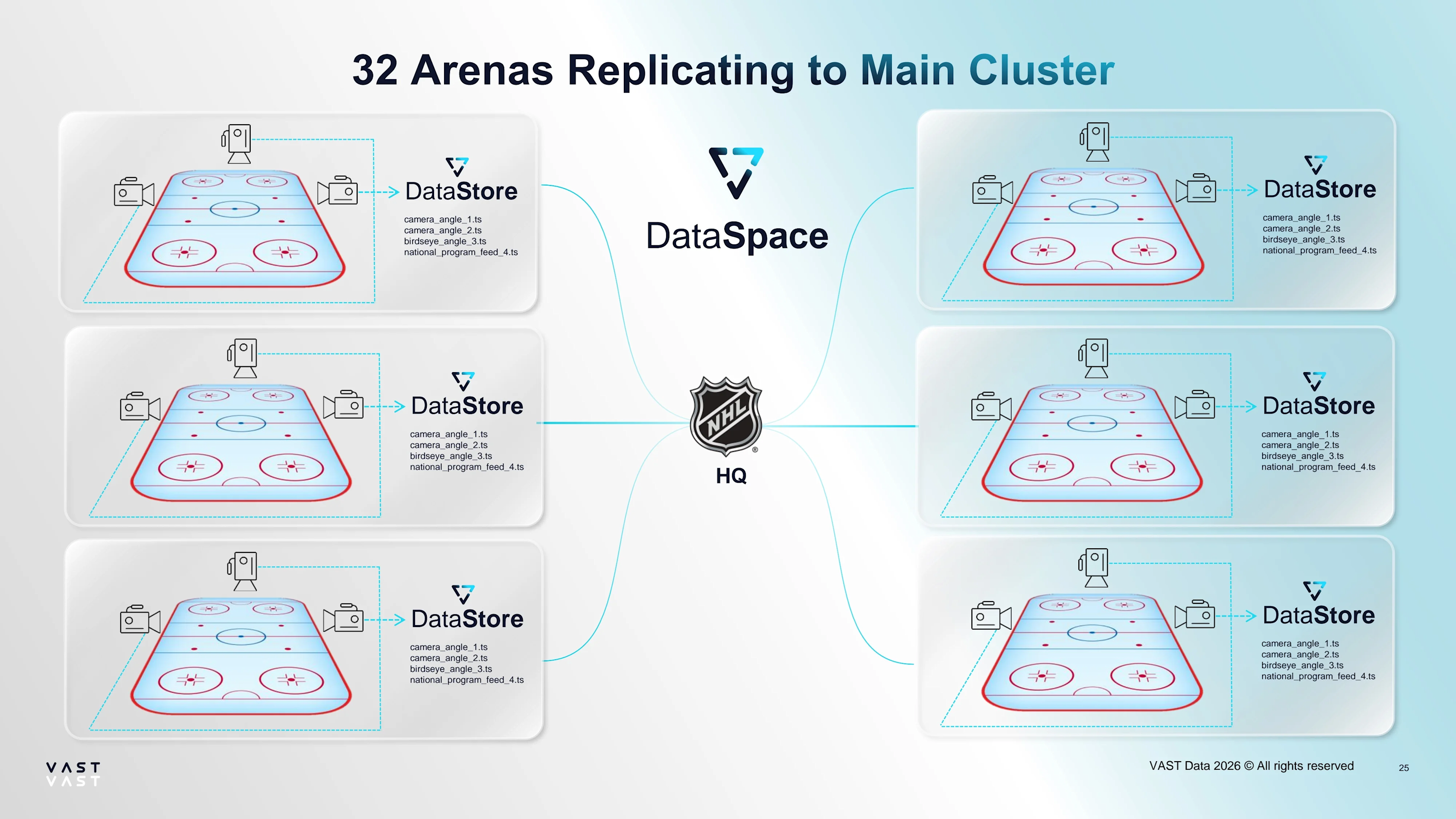
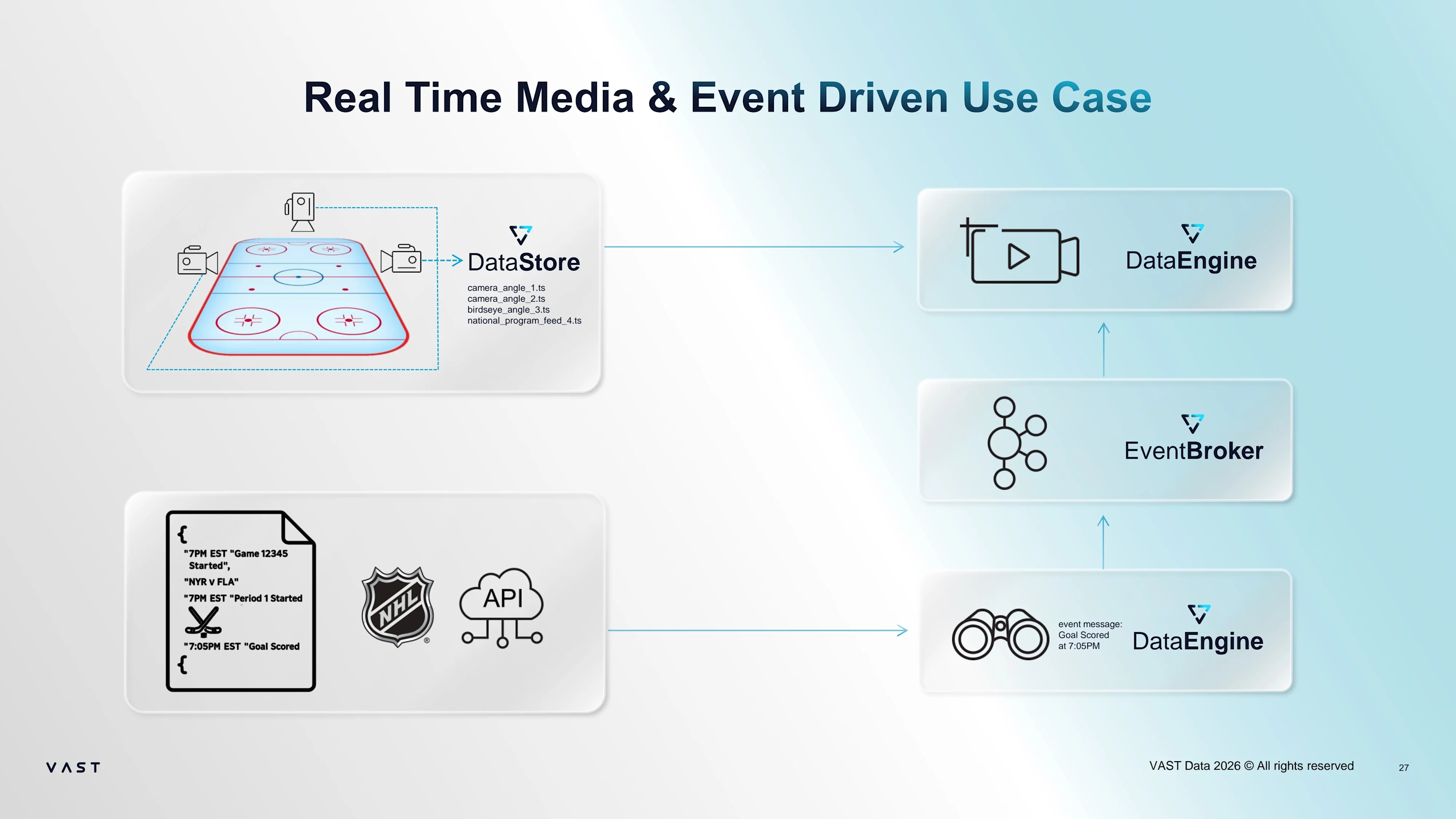
The traditional workflow for a road game was brittle: wait for the game to end, initiate a massive UDP transfer of several terabytes back to headquarters, and only then begin processing. The new paradigm moves processing to the source using the VAST DataEngine. The NHL now leverages an “Event-Driven” clipping pipeline that segments game footage automatically as periods end. “The last thing you need when the broadcast ends is to be waiting for those last bits... now we can have these files growing back at our headquarters,” Kennedy said.
With a single 8K camera writing 15GB of data per minute, organizations can no longer afford to move data before analyzing it. A durable foundation allows these workloads to live right next to where the data is written, turning raw video into structured assets during the broadcast.
Managing Scale through Infrastructure as Code
For the architect, a durable system must be simple to manage at scale. Managing 36+ disparate clusters would be a “bear” without a modern approach. The NHL resolved this by utilizing a Terraform provider to manage their clusters as infrastructure as code, preventing configuration drift across the 32 arenas.
This architectural simplicity allows organizations to collapse their production pipeline. By using a global namespace that supports NFS, SMB, and S3 simultaneously, teams can eliminate the “copy-paste” tax. The NHL even writes archival data as S3 objects with metadata tagging, providing the flexibility to request files via natural language search rather than manual file path navigation.
The Forward-Looking Insight
As we move toward 10.5K cameras (hockey fans rejoice!) and agentic logging, the definition of “durability” is evolving. It is no longer enough for storage to be a passive box.
We are moving toward a world where AI agents scan feeds 24/7, auto-tagging goals and generating highlights before the crowd has finished cheering. Building a durable architecture means building a foundation that doesn’t just store the game but understands it.
“The partnership we’ve had with VAST has been a really, really productive one,” Kennedy says.
As the sports calendar reaches one of its annual peaks, the pressure on the underlying infrastructure only intensifies. In moments like these, when leagues are generating massive volumes of live content simultaneously, durable architecture stops being a backend concern and becomes part of the fan experience itself.


