

Sovereign AI is more than where data is stored or compute runs. AI systems retrieve, embed, cache, infer, log, and act on sensitive data across distributed workflows. Governments, enterprises, and sovereign cloud providers need infrastructure that proves control across the AI data lifecycle.
Sovereign AI infrastructure by VAST Data
Enforce Sovereign AI at The Data Layer
VAST Data delivers the foundation for sovereign AI, enabling governments, enterprises, and cloud providers to build AI infrastructure without sacrificing scale or speed. See how forward-thinking nations are deploying it today.

The Sovereign AI Challenge
Residency is not enough. AI Expands the Sovereignty Boundary.
Residency Without Control
Data may sit in an approved location but still be exposed through unmanaged copies, weak access controls, support processes, fragmented logs, or AI pipelines that cannot be reconstructed.
Fragmented Data and Evidence
Legacy architectures scatter data, metadata, vector indexes, audit logs, and governance controls across systems. That makes it harder to prove who accessed what, where data moved, and how AI used it.
AI Expands the Control Boundary
Prompts, embeddings, retrieved context, inference logs, cache, and agent actions can all contain sensitive information. Sovereign AI requires control across these new surfaces, not just the original dataset.
Our mission is to empower innovators across Canada and beyond with the tools they need to build the future of AI – securely and independently. The VAST AI OS lets us scale effortlessly while delivering the security and performance our customers demand, and VAST’s AI-native architecture aligns perfectly with our vision of a flexible, sovereign, multi-tenant AI cloud.
Craig Tavares
President and COO, BUZZ HPC

Why Now
Sovereignty is Moving from Policy to Operational Proof
Governments and enterprises are moving from AI experimentation to production AI in critical services and regulated workflows. That changes the sovereignty question. Buyers no longer need only a statement of where data resides. They need evidence of how sensitive data is accessed, governed, used by AI systems, recovered, and moved when risk, regulation, or provider strategy changes.
AI makes this harder because data no longer stays in one place. It may appear in source systems, metadata catalogues, embeddings, vector indexes, prompts, retrieved context, inference logs, cache, and agent actions. Each becomes part of the control surface.
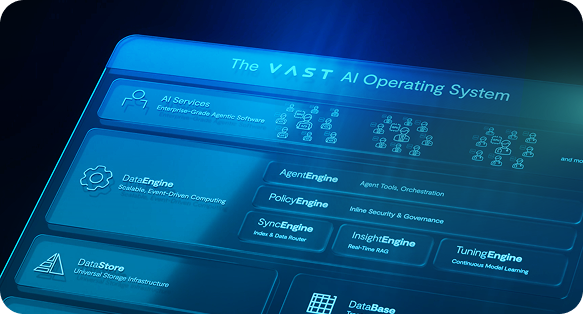
VAST Data helps address this challenge at the data layer. The VAST AI Operating System, built on Disaggregated Shared Everything (DASE) Architecture, provides a unified foundation for governed data access across private, sovereign cloud, public cloud, GPU cloud, colocation, and hybrid environments.
This helps organizations support AI innovation while maintaining stronger control over data placement, usage, auditability, and portability.

VAST’s Role in Sovereign AI
VAST AI OS: The Data Foundation for Sovereign AI
VAST AI OS offers a unified data foundation for sovereign AI infrastructure. Helping organizations govern access, reduce data movement, support AI-ready operations, and preserve control across private, sovereign, and public cloud environments. VAST’s role is to help make sovereignty decisions enforceable at the data layer.
Unified Data Foundation
VAST AI OS brings file, object, block, table, metadata, and AI data services into a common architecture, reducing the fragmentation that makes sovereign AI difficult to govern.
Governed Access and Evidence
VAST supports data-layer controls for access, encryption, auditability, and multi-tenancy, helping organizations find evidence of how data is accessed and used.
Portability and Resilience
VAST helps organizations preserve deployment choice across private infrastructure, sovereign cloud, GPU cloud, public cloud, colocation, and hybrid environments.
The Three Pillars of Sovereign AI
Breaking Down Legacy Storage Limitations
Govern Data without Unnecessary Movement
The VAST AI OS provides unified data management that eliminates the trade-offs designed into legacy storage systems. VAST replaces fragmented silos with a unified, AI-optimized platform that delivers performance, scale, operational simplicity, and control over where data resides and how it is accessed.
Apply Policy and Evidence Across Environments
With legacy storage, each silo has its own ACL model, encryption, and audit trail. VAST AI OS provides consistent data encryption, role- and row-based access controls, and access-controlled audit trails into every operation. Ensuring that each piece of data carries its own policies and evidence. Governance travels with the data, across sites, clouds, and borders.
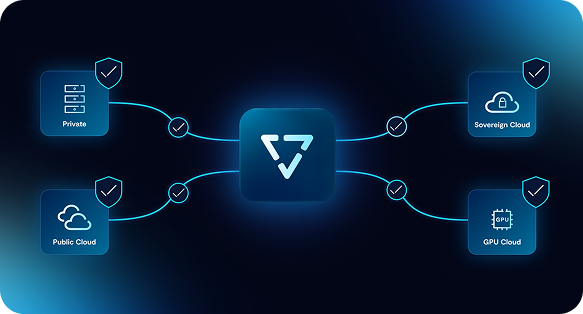
Preserve Control across Sovereign, Cloud, and Hybrid Deployments
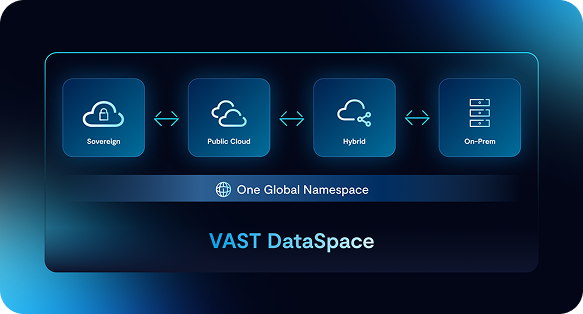
Sovereign AI programs are forced to copy and sync data across sites, regions, and sovereign clouds, creating stale copies, governance gaps, and project delays. With VAST DataSpace, every location becomes one shared namespace. Metadata synchronizes globally, with no copies or silos, and data never leaves the jurisdiction that its residency rules demand.
What does DataStore help Sovereign AI do?
A Universal Storage Platform for Sovereign AI
VAST DataStore consolidates training data, model checkpoints, embeddings, application data, and model outputs into a unified, high-performance storage architecture that can remain under national or organizational control.
Exabyte Scaling
DASE can scale data services as GPU demand grows without migrating datasets between storage controllers. Capacity can be added as datasets, checkpoints, and model artifacts expand.
Multi-Tenancy and Access Isolation
Support for tenant-specific namespaces, virtual IPs, access policies, encryption keys, quotas, and QoS controls. Allows national AI factories to serve multiple agencies, institutions, or ministries.
Unified Element Store
Different stages of Sovereign AI can use their preferred interface while using a common controlled dataset. Expose directories as NFS exports, SMB shares, S3 buckets, or block-enabled views.
Auditing
Access-controlled audit records that provide a tamper-resistant history of data access and operations. Records may be queried through management tools, APIs, or analytics engines.
What does DataSpace help Sovereign AI do?
Unified Data for Sovereign AI Apps
VAST DataSpace helps organizations reconcile data sovereignty with GPU accessibility. It keeps sensitive data within approved locations while providing authorized AI compute with fast, governed access through a unified global namespace. Reducing data duplication, preserving control, and accelerating sovereign AI development.
Policy-Controlled Global Namespace
Each global folder has defined placement, caching, replication, and access behavior, allowing companies to keep datasets within designated jurisdiction while presenting them to GPU infrastructure.
Pre-Fetch Data
Satellite clusters cache data on local SSDs and prefetch metadata or full datasets before AI jobs start. This provides GPUs with local, all-flash access while preserving a consistent view of the data.
Authorized Data Boundaries
Highly restricted data can be limited to satellites inside a national boundary, while less sensitive datasets are made available to approved regional clouds.
VAST AI OS by Industry
Sovereign AI in action
Sovereign AI requirements vary by sector, but the common challenge is the same: sensitive data must be made useful to AI systems without losing control, governance, auditability, or deployment choice.