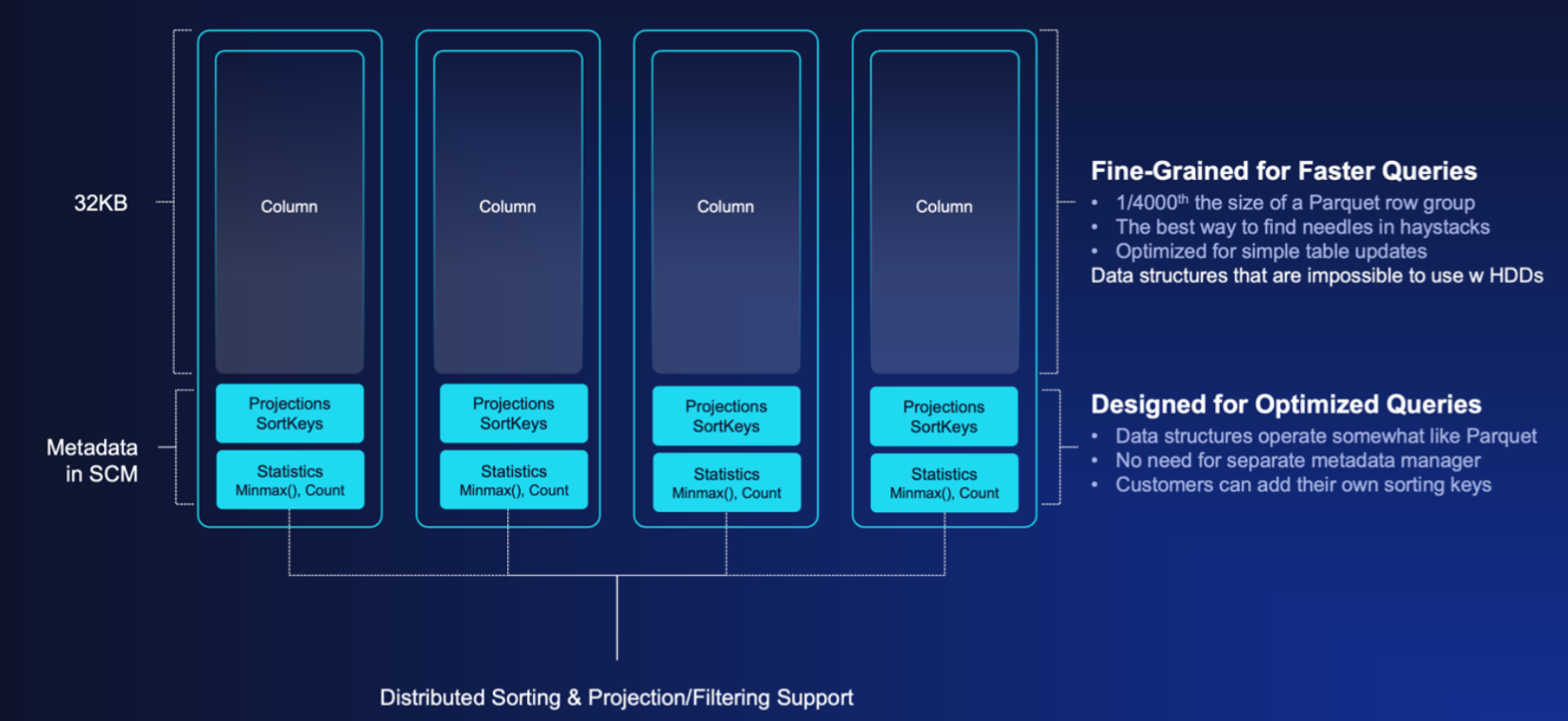
In this new world, records don’t land in some temporary buffer. They’re immediately written to persistent, stable storage in a column oriented layout, as opposed to rows that need restructuring later. They go in clean, stripe-aligned, and query-ready. Each extent is ~32KB on average. Small enough for high-performance ingestion. Large enough for analytical scans.
Later, those extents are migrated to flash, coalesced with other data but never rewritten, never copied into a different shape. That write-once-read-many trick applies whether the original input was a 300GB model checkpoint, or a 14-column transactional row.
There is no distinction, it’s all just data, managed by the same system, governed by the same metadata plane.
But Here’s Where Most Systems Break...
To understand why this matters, let’s go back to that query. One billion rows. Ten matches. A needle-in-haystack scenario.
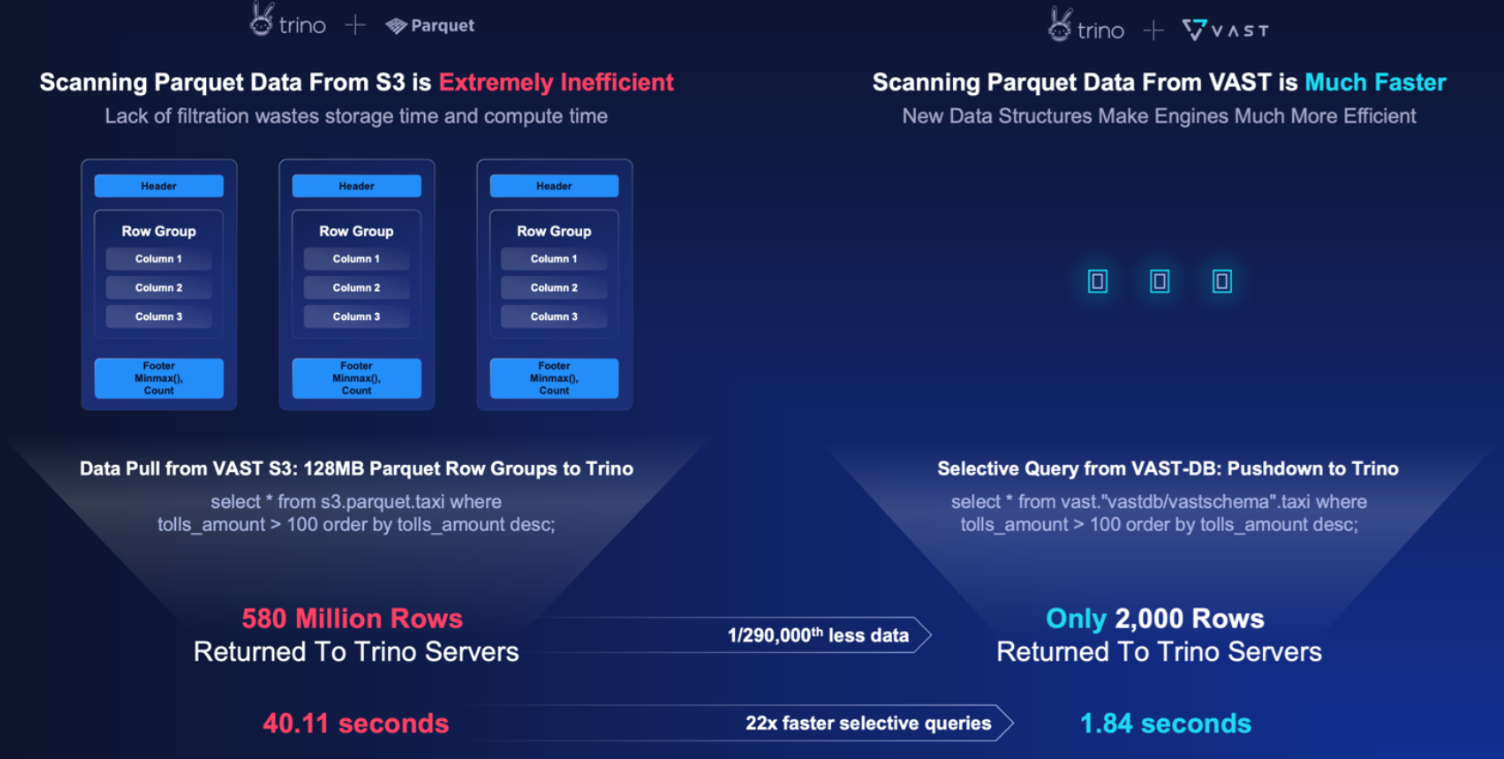
On Parquet or ORC—on Iceberg or Delta Lake—you’re reading MBs or GBs just to filter 99.9% of it away. Even with partition pruning. Even with caching. The engine reads, deserializes, filters, and discards. What that ultimately means is that your CPUs are busy, your memory’s overcommitted, and your I/O bill just went up. Again.
And even then, the result takes seconds.
With VAST DataBase, that query pushes down its predicate—its filter—into the database itself. The Element Store resolves which extents matter and which don’t. So the engine only touches the blocks it needs. There is no overscan. There is no post-filtering in memory. The infrastructure does it before the query engine ever sees a byte.
That’s not an optimization. That’s a redefinition of the query boundary. And the meaty thing here is that you’re not accelerating Trino or Spark. You’re shrinking them.
Because with predicate pushdown that actually works, and ingestion that doesn’t create I/O bottlenecks, the compute layer gets dramatically smaller. Fewer nodes. Less memory. Less ephemeral cache management and fewer retries.
At the end of the day that that means is that what used to take a ten-node cluster can now run on three. What used to cost you $2,000/month to run 24/7 costs $400, or less in this hypothetical scenario.
Speed is nice. Cost is nicer. Both? Chef’s kiss.
Not to Bore You With Transactional Insert Performance But….
You probably know that columnar systems aren’t supposed to be good at inserts. That’s the rule. That’s why you buffer and batch. That’s why you write append-only logs and hope you can compact later without melting your IOPS budget.
But VAST DataBase handles ingestion the same way it handles file writes: atomic, immediately visible, and formatted for future scans.
There’s no fake row-first staging layer. No second system for write optimization. You can insert, kid you not, millions of records per second, in native columnar layout, with no post-processing required.
If you’ve ever tried to insert records into Iceberg in real time, you already know the experience: low throughput, immutable file churn, constant rewrites, and an eventual showdown with your cloud provider over the number of PUTs per hour.
Here, ingestion just works. Structured data is no longer a special case.
The Collapse of Complexity
What VAST DB represents isn’t the arrival of another database on the scene. It’s the disappearance of the artificial boundary between ingestion and insight.
Historically, that boundary made sense. Columnar was slow to write, fast to read. Row-based was the opposite. So we built two stacks. And then we built pipelines to connect them. And then we built orchestration layers to manage the pipelines. And then we built observability tools to manage the orchestration.
All of that—every tool, every script, every cloud bill bloated by unnecessary handoffs—was an expression of architectural deficiency.
VAST DB removes the need for all of it. Not because it reimagined the database. But because the infrastructure underneath it never learned to draw those lines in the first place.
It treats structured and unstructured data the same. It stores it the same. It moves it the same. It indexes it with the same metadata engine. It migrates it across the same flash tiers, the same protection schemes, the same atomic workflows.
There is no handoff. There is no translation layer. There is just data. Inserted, queried, managed.
Wait, Does This Mean You Don’t Need Two Systems?
The modern data stack has been lying to itself for a while.
It tells a story of flexibility, openness, modularity. But underneath that story is a hard truth: you can’t patch over fundamental limitations forever. At some point though, the physics break through. At some point, you have to stop layering and start redesigning.
That’s what happened here—not a new product line, but a collapse of unnecessary layers.
VAST DB isn’t a “database product.” It’s an expression of a deeper design principle:
If your infrastructure doesn’t care what shape your data is, your software doesn’t have to either.


