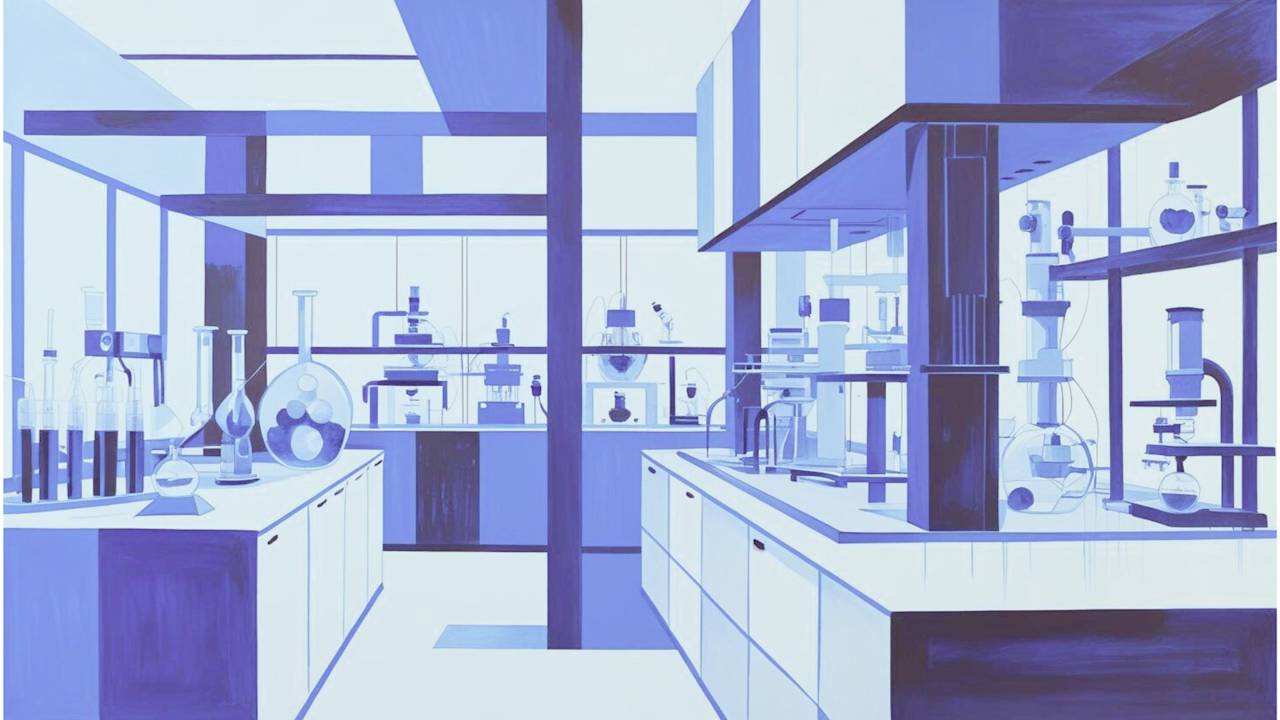
At Stanford, James Zou is building virtual labs of AI researchers, an academy of code with its own labs, schools, and conferences reshaping how science is done.
What happens when science starts to reproduce itself?
At Stanford, James Zou is building laboratories made entirely of code. Of virtual teams including AI researchers with professors, students, and specialists in fields from immunology to chemistry.
They argue, they design experiments, they even generate vaccine candidates, presenting an early sketch of what Zou, a Stanford professor, defines as a second academy, one that looks less like a tool for scientists and more like a scientific community of its own.
Zou has begun to assemble this collection of agentic AI entities designed not just to assist research, but to act as researchers themselves. The framing is deceptively simple: a PI agent at the top, graduate-student agents beneath, each specializing in domains like immunology, chemistry, or computational biology.
The radical shift becomes clearer when you trace how these agents work. A single chatbot, even a very good one, good at summarizing knowledge but lacking the means to act on it. Zou’s agents, by contrast, are equipped with actual scientific tools, so think AlphaFold for protein folding, Rosetta for molecular design, and databases for cross-referencing. And when his team tested their computational creations in a wet lab, the molecules held up. they bound to Covid spike proteins just as predicted. Here was a set of hypotheses not generated by a human immunologist, but by a lab of artificial ones.
And because the lab is virtual, it scales with almost comic ease. While a human PI can only run a handful of projects, Zou can spin up as many agentic labs as his compute budget allows. Collaboration requests no longer mean years of time he doesn’t have, they mean forking off a new lab instance and letting the agents get to work.
In effect, he has found a way to clone his intellectual capacity, not as one all-knowing supermodel but as a society of smaller specialists.
But to build a society, you need more than capacity, you need culture, he argued at the Agents of Tech 2025 conference. Zou’s agents communicate in natural language, visible to their human overseers, which means you can watch their conversations unfold like lab meetings. They even developed the same social quirks as their human counterparts (too agreeable, too quick to nod along). So his team introduced a “critic agent,” a kind of permanent peer reviewer tasked with injecting skepticism into the discussion. The first glimpse, perhaps, of an AI scientific culture with hierarchies, conflict, and with peer review.
And what is science without schools? Zou’s lab has built those too. He calls it the “virtual lab school” a self-training environment where agents go to become specialists. They identify gaps, retrieve papers, textbooks, and even GitHub code to fill them. They also read, fine-tune their own models, quiz themselves, and loop until competent. Basically, what would take a graduate student years takes an AI days, Zou says.
The idea that you could enroll an agent in “chemistry class,” let it binge the corpus of the field, and graduate it as a lab-ready expert is the kind of thing that feels like parody until you see it working.
Zou also recently launched an AI conference called Agents for Science where agents serve as authors, reviewers, and attendees. The exercise is partly provocation. If human journals refuse AI coauthors, why not build a venue where agents can publish freely? Humans already struggle with the deluge of papers at every conference, he argues, but imagine an academy where labs of code can write, review, and revise at machine speed.
The question is no longer whether AI can be a scientist, it’s happens when science itself becomes a multi-species ecosystem, with human and artificial researchers cohabiting the same intellectual space.
The skeptics, of course, have their own point. The joy of science is not only in the result but in the messy, serendipitous argument, the inspiration sparked by someone else’s offhand comment or the late-night idea sparked by a conversation. Can a critic agent really reproduce the joy of intellectual disagreement? Can a lab of silicon immunologists stumble across the unexpected, or will they only validate what was already in the data?
Zou is careful not to overclaim. He agrees that an AI hypothesis still requires validation in a physical lab. Proteins must be synthesized, assays run, results confirmed. The wet lab remains the ultimate arbiter of truth. And that means human expertise remains central. He also frames the agents not as competitors but as collaborators, always there when a specialist can’t be found, always reading more literature than any human could manage.
If there is a bottleneck in scientific progress, it is usually the scarcity of domain expertise. Virtual labs loosen that bottleneck.
Still, there is a deeper question emerging, one that the scientific community has barely begun to ask: if we build a parallel academy of code, what happens when it starts to evolve on its own? When schools for AI train more teachers who then train more agents; when AI conferences grow into archives larger than any human could parse; when critics sharpen critics until whole debates play out beyond our comprehension?
The academy we know has taken centuries to develop its rituals of trust, publication, and review. Zou’s ecosystem could spin up thousands of such communities in months.
The image is, well, kind of medieval: two academies side by side, one human, one algorithmic, each with its labs, its schools, its conferences. The human one is bounded by scarcity of time, attention, expertise. The algorithmic one is bounded only by compute and curation. The first is joyous and slow; the second is tireless and infinite.
The challenge of the next decade will be finding ways for these two to meet, to coauthor, to critique, without drowning each other out.


