
At GTC DC, leaders from Lambda, Together AI, Poolside, and Reflection AI argued that America’s AI future depends on building resilient, sovereign AI factories.
At GTC DC last week, a panel of infrastructure builders described a new kind of arms race. The conversation was far less about algorithms and benchmarks but rather focused more on steel, power, and proximity than we’ve seen at AI conferences to date.
The argument made by one particularly solid panel was that American leadership in AI will depend on how quickly it can build the physical systems that sustain intelligence at scale. These AI factories are not datacenters in the traditional cloud sense but are engineered production lines for computation, purpose-built to train, serve, and secure the models that will shape economic and strategic power.
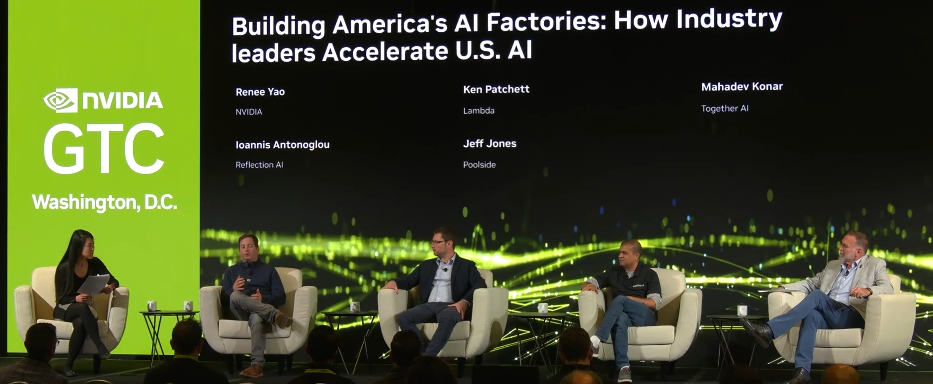
Ken Patchett of Lambda ( (who we’ve talked to about this on the Shared Everything podcast) called it a collective effort that begins at the ground level.
“You can’t do this by yourself,” he said. “You move into a community and you're doing something that they've never seen before, and you're like some alien that landed from outer space. You've got to understand, you have to have a partnership in every corner.” To him, the future of AI infrastructure will be determined as much by social trust and power capacity as by silicon.
“Every electron we consume should be done for a reason. And we should bring value to a community, not take from it,” Patchett adds.
That very sense of locality, of AI as an industry built town by town, substation by substation, also framed the discussion.
Each speaker described an ecosystem that sounds a whole lot like the early days of industrial manufacturing, where progress depended on material throughput, stable power, and public alignment.
Permits, land rights, and cooling systems now matter as much as compiler optimizations and the new competition is over who can build the most efficient national machine for intelligence.
Ioannis Antonoglou of Reflection AI tied that competition to openness.
“The open protocols and the open infrastructure is the one that shapes each revolution,” he said. “It was built on top of open protocols. It was built on top of most of the servers like use Linux as like the operating system, and being open ensures that you can have the leadership in the new build out of infrastructure.”
This warning is that a country unable to produce its own open frontier models will rely on others for the most valuable resource of the coming decade. “It's either you export this technology or you import it, right, like it's one or the other.”
Mahadev Konar of Together AI brought the conversation to the cluster level, where resilience defines progress. “If you're thinking about training on a 10k GPUs, we have to figure out how the interconnect works, how the networking layer is built.” His teams engineer failure tolerance into dense GPU clusters where faults are constant and cost is measured in time to retrain.
“Something is bound to go wrong when you are talking that big clusters,” Konar argued. “How quickly you can replace nodes, how quickly you can segment network issues and figure that out, all that becomes extremely important.”
The work, he said, is about sustaining scale through predictability rather than chasing it through expansion.
Jeff Jones of Poolside spoke from the edge of that system, where defense and government deployments redefine reliability as physical control. “You can't screw up.”
His company built its architecture for compliance and sovereignty from the start, able to run “within data centers on bare metal” or “strapped to the back of a Humvee.” His concern extended to the growing use of agents within secure systems. “You're now giving these agents more access to read write into production systems with PCI data and HIPAA data. And if you're giving those agents those types of controls, you need to have full auditability, observability, control of that and really be careful with where your data is going.”
By the end, the theme hardened into something larger than efficiency or market share. Patchett called for deliberate, long-term intent in how these factories are built. “Pick your path and commit,” he said. “If you're not intentional in the work that you are doing, you are not going to get where you need to go.”
What he and the others described was an industrial foundation for intelligence, not a metaphor. It will be measured in gigawatts, fiber miles, and the steadiness of the people willing to build it.


