
At GTC DC, between sessions on trillion-parameter inference and grid-level datacenter design for the public sector, VAST co-founder Jeff Denworth sat down to talk about the moment a software company crosses over into system design.
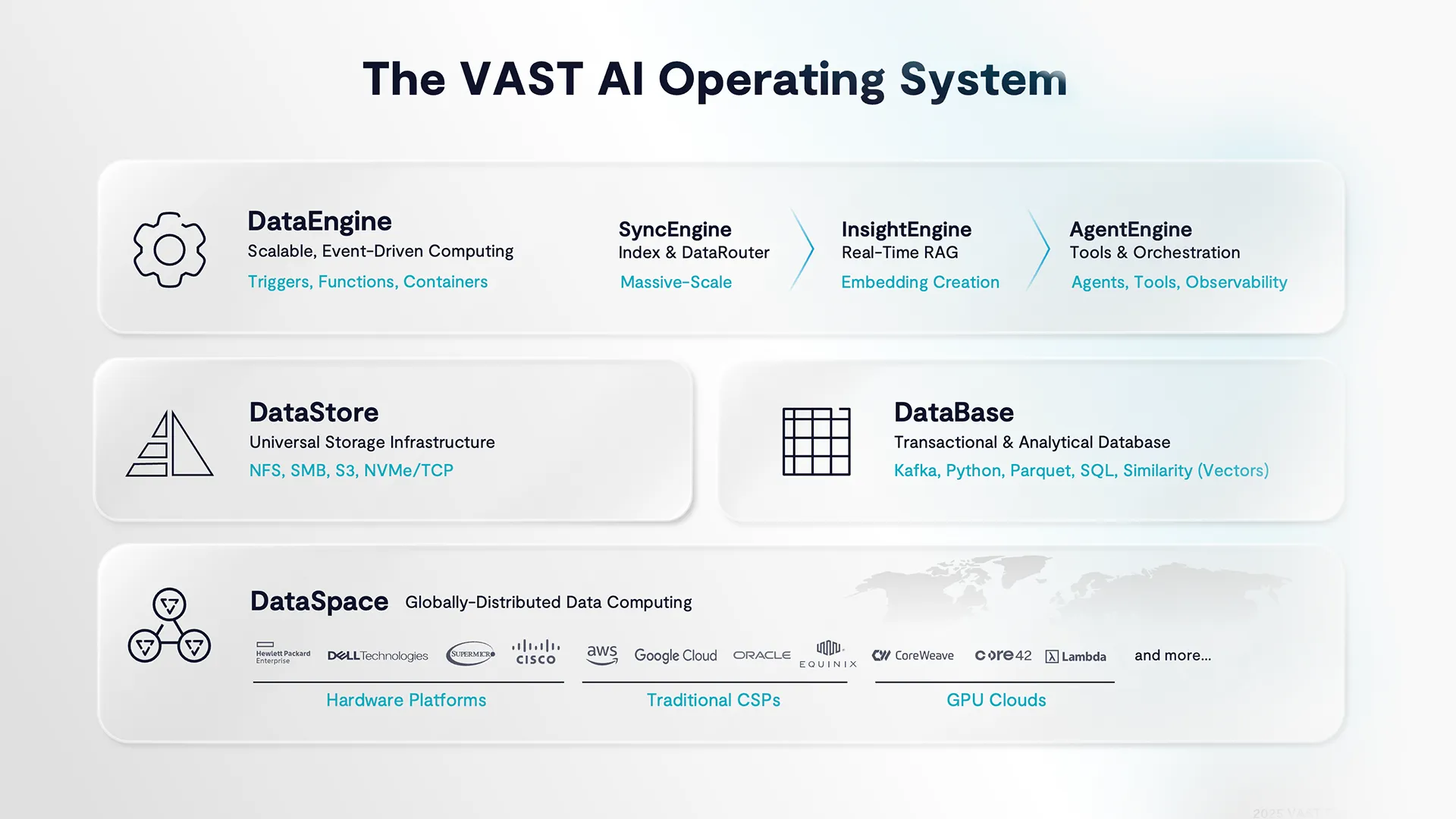
He’s referring, of course, to the massive changes brought about version 5.4 of the VAST AI Operating System where every layer of infrastructure, from the object store to the event stream to the runtime itself, has fully become part of a single distributed computer that can reason about data as it arrives.
Denworth calls it the largest software release the company has ever done, roughly sixty features, but the number hardly matters. What actually matters is what it unlocks on the ground across some of the largest system and model builders on the planet.
When we started the company, the idea was to build a computer in software that could scale without bound,” he says in the interview below. “We started with storage, then added database services, and now we’ve added the distributed runtime. That means when a piece of data hits the system, you can append a few functions and the machine gets to work contextualizing it, storing it, and preparing it for queries.
The phrase “distributed runtime” sounds abstract until you actually see it in action. For instance, in the case of smart cities as a representative example, a camera feed enters the system. Functions trigger. Embedding models run against the stream, generating vectors that describe the scene mathematically.
Those vectors, now a native data type inside the VAST DataBase, can be searched, reasoned over, and acted upon by agents.
The storage system becomes an active participant in understanding what it holds and the implications of that are already visible, Denworth says.
One new deployment sits at the core of one of VAST’s customer’s smart city programs, where sensor and video data flow through a reasoning engine that identifies patterns, raises alerts, and directs response.
“It’s like having a security guard who can watch every monitor at once,” Denworth said. The same pattern is moving through media, where leagues and broadcasters are reprocessing decades of footage into searchable context, and through research and homeland systems where continuous sensing is now computationally viable.
The technical leap behind this is the ability to perform high-speed vector inserts and queries at massive scale.
Traditional vector databases, built on legacy “shared nothing” architectures, crumble when events arrive by the millions per second. But VAST’s shared-everything design treats the vector store as a native function of the cluster itself. It can write, index, and retrieve in real time, at constant latency, across trillions of vectors.
The result is a platform that acts as a unified computer rather than a stack of disconnected services. One global namespace, one runtime, one event system.
It also brings the conversation back to parallelism, a concept Denworth has spent most of his career chasing.
I think about parallelism a lot,” Denworth said. “In this disaggregated, shared-everything architecture, no two machines have to talk to each other to do anything. That’s what makes it embarrassingly parallel.
What he’s saying here is that problems that have defeated other distributed systems (synchronization, chatter, event-stream collapse and the like) are effectively dissolved. Take for instance an AI lab that had been building custom Kafka clusters for reinforcement learning realized halfway through a meeting that they no longer needed them. The infrastructure for parallel reasoning already existed in the VAST platform.
Behind that architecture is a philosophy that has remained stubbornly consistent. The company began building when storage was considered a dead market.
“We just started in a very unsexy time,” he said. “We didn’t overhire, we built carefully, and we stayed on the same path.” That patience is visible in how each release fits into the next.
Storage became a database, the database became a compute substrate, the compute substrate became an operating system.
The VAST AI OS includes an SDK and runtime that expose every layer of control, from the event engine to the device driver. Developers can program directly against the system, which can scale from a single rack to an entire datacenter.
You have a computer that you can scale across datacenters,” Denworth said. “That’s why we call it an OS.
To him, this moment feels like returning to an earlier era of computing, when the boundaries between hardware and software were porous and system design was the main act of innovation. “Hardware really matters again. But what matters most is how hardware and software come together.” The shared-everything model depends on that unity, drawing efficiency from every layer to drive down token cost and energy per operation.
The philosophy extends beyond performance and becomes about removing the artificial separations that have kept infrastructure locked in categories.
“At some point, someone decided you didn’t need to buy RAID controllers anymore,” he said. “The capability got folded into something more sophisticated.” The same is happening here. Storage, database, event system, runtime, and scheduler are collapsing into one continuous system that understands data in all its forms.
What began as a point release now marks the boundary between incremental development and architectural change. 5.4 is where software becomes an environment, where data infrastructure stops waiting to be queried and starts thinking alongside the workloads it supports.
For VAST, it represents a long-term bet paying off. For the rest of the industry, it represents a reminder: systems are never finished, only reimagined.
Listen to the full conversation with Denworth on the Shared Everything Podcast.


