
VAST Polaris is a Kubernetes-based global control plane that deploys and governs VAST AI OS clusters across hybrid and multicloud environments. For enterprises, that means globally distributed AI infrastructure runs as one platform that’s centrally managed, consistently upgraded, and ready to scale without operational sprawl.
AI infrastructure is no longer confined to a single datacenter or a single cloud. Modern AI systems span regions, providers, and operational domains. Training might occur in one geography with inference in another. And data may originate at the edge, aggregate in public cloud, and persist on-premises for governance. What was once cluster-scale infrastructure is now globally distributed infrastructure.
This next phase of AI demands operational coherence at global scale and VAST is delivering with Polaris, a Kubernetes-based, intent-driven global control plane designed to orchestrate the deployment and lifecycle management of VAST AI OS clusters across hybrid and multicloud environments.
Polaris extends the VAST AI OS beyond individual clusters, transforming distributed infrastructure into a centrally governed, fleet-scale AI platform.
A Global Infrastructure Control Plane for AI
Polaris operates as a secure, centralized control layer that governs how VAST AI OS instances are provisioned, upgraded, expanded, and interconnected across public cloud and on-premises environments.
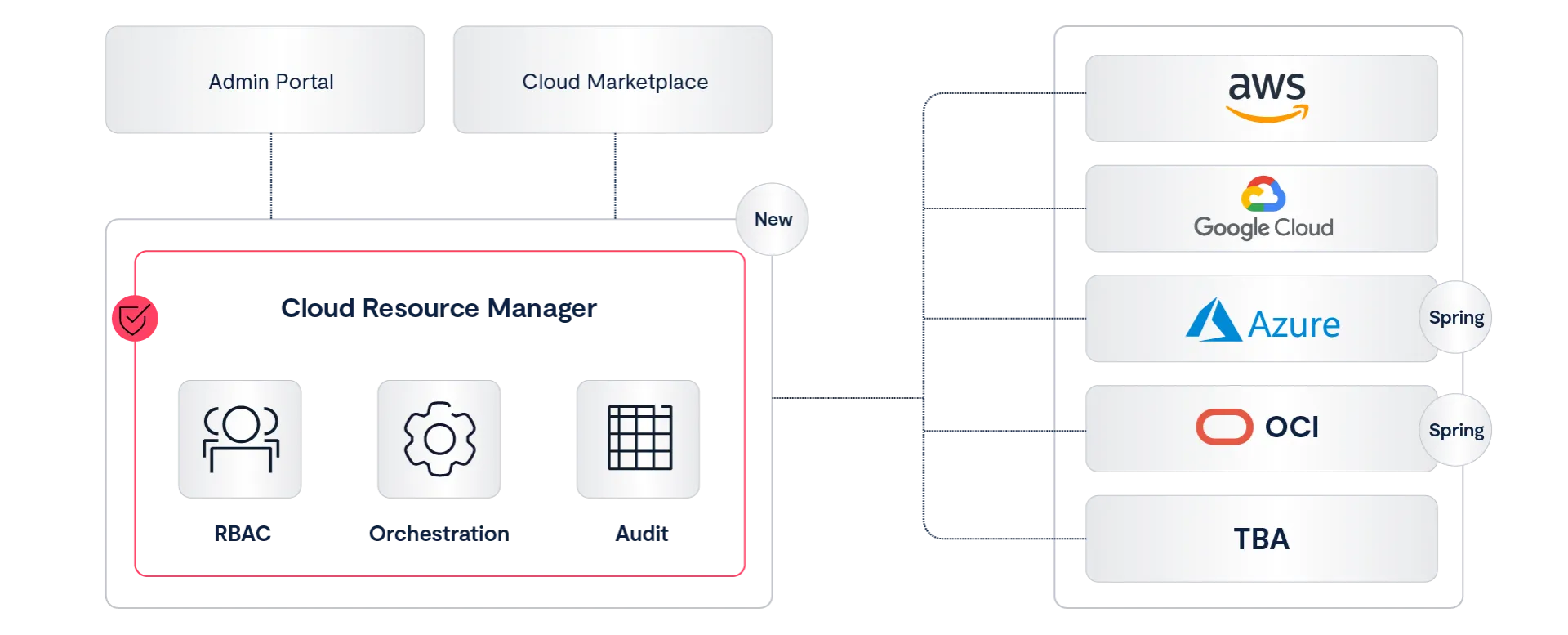
At its core, Polaris is built on a Kubernetes-based control plane architecture. Lightweight agents run on every VAST node, continuously reporting state and receiving configuration directives. Administrators define a desired infrastructure state through a single API and interface. The Polaris reconciles actual cluster state with that intent, enforcing configuration consistency across the entire fleet.
This declarative, desired-state model eliminates manual orchestration of multi-cluster environments. Upgrades, node replacements, cluster expansions, and configuration changes are centrally defined and automatically applied, ensuring deterministic lifecycle management at scale.
Infrastructure becomes programmable and policy-driven, not manually administered.
Fleet-Scale Orchestration Across Hybrid and Multicloud
Distributed AI infrastructure often results in fragmented silos. Separate operational domains emerge across clouds and datacenters, complicating governance, cost control, and security posture. It all comes together when we see how Polaris unifies those domains.
Through its centralized control plane, Polaris enables administrators to manage geographically dispersed AI clusters through a single, secure interface. It abstracts provider-specific deployment mechanics and presents a consistent operational model across cloud-native and on-premises resources.
By integrating directly with hyperscaler marketplaces, Polaris simplifies subscription management and entitlement workflows. Organizations can deploy VAST AI OS clusters in public cloud environments while maintaining consistent lifecycle governance across their entire infrastructure fleet.
This abstraction of infrastructure location enables workload mobility without operational fragmentation. AI systems can scale across regions and providers without re-architecting management processes or compromising governance controls.
Polaris and DataSpace: Infrastructure and Data Abstraction Working Together
VAST DataSpace provides the distributed namespace and global data fabric that unify clusters across environments. It abstracts data location, enabling AI agents and applications to access data seamlessly regardless of physical placement.
Polaris operates above that layer. Where DataSpace abstracts data location, Polaris abstracts infrastructure location.
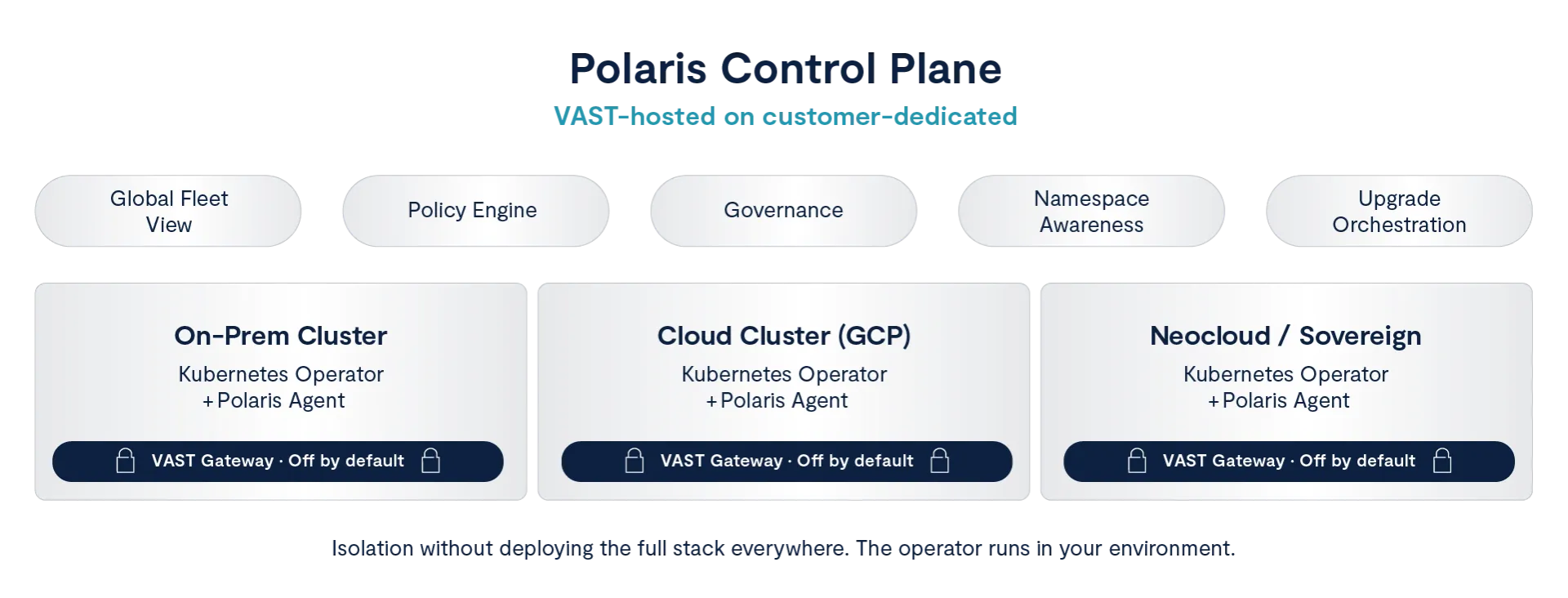
Polaris governs how VAST AI OS clusters are instantiated, secured, upgraded, and interconnected. DataSpace governs how data is distributed and accessed across those clusters. The VAST AI OS unifies execution, storage, and services within each cluster.
This separation of responsibilities preserves architectural clarity while enabling global scale:
Polaris maintains infrastructure state across environments.
DataSpace maintains data fabric state across clusters.
The VAST AI OS delivers high-performance execution within each deployed instance.
Together, these layers transform physically distributed systems into a single logical AI data platform.
Intent-Driven Automation and Desired State Enforcement
Polaris introduces intent-driven automation to distributed AI infrastructure.
Administrators define the desired topology, configuration, and policy posture of their AI fleet. Polaris continuously monitors node health, configuration drift, and cluster integrity, reconciling deviations to maintain the defined state.
This architecture aligns with cloud-native control-plane principles:
Declarative configuration
Continuous reconciliation
Secure agent-based enforcement
Centralized API-driven management
By coordinating both cloud-native services and on-premises resources, Polaris ensures a secure, globally consistent infrastructure posture. Identity integration, policy enforcement, and lifecycle operations are unified across all environments.
Operational consistency becomes a property of the platform, not a function of manual processes.
Enabling GPU-Aware, Globally Distributed AI Systems
Modern AI infrastructure must align compute placement with GPU availability, cost dynamics, and regional latency constraints. Polaris enables centralized fleet orchestration that allows infrastructure placement decisions to be made without changing application logic.
Clusters can be deployed or expanded in response to workload demand, geographic requirements, or economic conditions. Infrastructure becomes elastic at global scale while remaining operationally unified.
By transforming isolated deployments into a coherent fleet, Polaris enables distributed AI systems to scale without fragmenting operational control or governance.
Executive Perspective
AI infrastructure is evolving from cluster-scale deployments to globally distributed systems,” said Jonsi Steffenson, Cloud GM at VAST Data. “Polaris provides the infrastructure control layer that allows the VAST AI OS to operate consistently across cloud and on-premises environments. When paired with DataSpace, it enables enterprises to unify both infrastructure and data into a single logical AI platform.
A Foundation for the Next Phase of Distributed AI
As AI systems evolve toward agentic workflows, real-time inference, and globally distributed data pipelines, infrastructure abstraction becomes foundational. Abstracting data location is necessary. Abstracting infrastructure location is equally critical.
Polaris represents the next architectural step for the VAST AI OS. It extends the operating system model beyond individual clusters and into a globally distributed control framework. Infrastructure is no longer defined by where it runs. It is defined by how it is governed.
Paired with DataSpace’s global data fabric, Polaris establishes a scalable foundation for distributed AI systems that demand performance, governance, and operational simplicity at exabyte scale.
VAST Polaris is available today as part of VAST cloud deployments, enabling enterprises to orchestrate distributed AI infrastructure through a single, secure control plane.


